
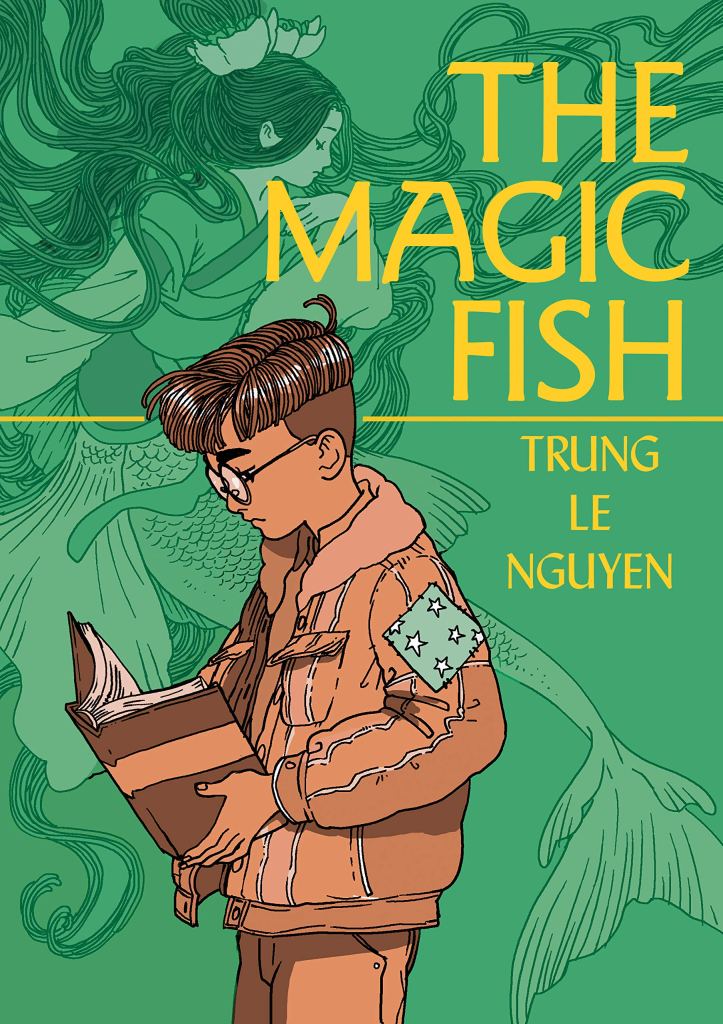
Review by Hannah Luppe
Random House Graphic, October 13, 2020
256 Pages, Paperback, $31.99 CAD, 9780593125298
Young Adult, Ages 12+
Graphic Novel, Fiction, LGBTQIA+, APIDA
The space between two shores is the ocean and being caught in between feels like drowning. And, really, what is the point of tears among so much salt water?
In real life, happily ever after isn’t always made of glass slippers and true loves’ kisses.
Trung Le Nguyen’s graphic novel The Magic Fish understands that life is much more complex than fairy tales seem to depict. Our main character, Tiến Phong, is a second-generation American Vietnamese teenager who is helping his mother learn English with a book of fairy tales. At the same time, he struggles with finding the right words to tell her about his queer identity as there is no direct translation from English to Vietnamese. Told alongside three carefully illustrated fairy tales, The Magic Fish is a profound reflection on the ways our stories—both those we’ve lived, and those we’ve read—are integral to our identities, and how we can use them as avenues of connection and compassion, even in the most difficult times.
Visually, The Magic Fish is stunning. The illustrations of the fairy tales are intricate and unique, the style of the images changing to suit the imagination of the character telling the story. Here, Trung Le Nguyen not only tackles language barriers, but different visual literacies as well, revealing that both communication and understanding come in many forms. The panels of the graphic novel are depicted in three different colours—purple, red, and yellow—to symbolize the present, the past, and the events in the fairy tales. While this visual technique allows for a convenient indication of time and place, it may put colourblind readers at a disadvantage.
By addressing themes of diaspora through the lens of two “Cinderella” stories and a reimagined version of “The Little Mermaid,” The Magic Fish equates the immigrant experience in North America to the nature of fairy tales. Both are always evolving and, therefore, never truly finished, even after the journey to a new home is complete. Trung Le Nguyen uses fairy tales to find common ground between Eastern and Western notions of happily ever after, thus allowing Tiến and his mother to connect with one another across barriers that might otherwise divide them. Similar to the way fairy tales are retold, The Magic Fish reimagines the notion that the North American experience is a perfect one, exposing the hardships and traumas immigrant families face while also preserving the hope of new beginnings.
Full of magic, longing, and warmth, this graphic novel is a love letter to storytelling with the unbreakable bond between a mother and her son at its heart. I would recommend The Magic Fish to any reader who is searching for a more authentic and relevant version of a happily ever after—you will most certainly find it here.
Hannah Luppe is currently completing her MA in Children’s Literature at UBC. She is the managing editor of Young Adulting Review.
 YOUNG ADULTING