Trung Le Capecchi-Nguyen (Trung Le Nguyen, professionally) is an award-winning Vietnamese-American cartoonist, artist, and writer from Minnesota.
Trung’s first original graphic novel, The Magic Fish, was published in 2020 through Random House Graphic, an imprint of Penguin Random House. He has been nominated for an Eisner, a prize at Angoulême (France), a GLAAD award, and has won two Harvey Awards and a Romics (Italy). Trung has also contributed work for DC Comics, Oni Press, Boom! Studios, Image Comics, and Marvel.
He currently lives in Minneapolis, Minnesota and raises a small flock of very spoiled hens.
Hi Trung! Thank you so much for joining us here at Young Adulting. We’re so excited to have you! In The Magic Fish, you revive old, worn fairy tales, turning them into avenues of connection and compassion. Can you tell us a bit about why you chose to use fairy tales when conveying themes of diaspora and queerness?
So many fairy tales are about transitions. They’re so much about negotiating and navigating all kinds of power, which is something we all do all the time. We love an underdog story, and we love stories about aspirations on their way to becoming realized. We even colloquially refer to them as Cinderella stories, and I think there is a lot in Cinderella that parallels the most optimistic aspects of an “immigrant dream,” in my case an American one. The Little Mermaid, though, is a bit more direct. I think Hans Christian Andersen used fairy tales to figure out his relationships to the ways he had to navigate social strata (The Princess and the Pea comes to mind), and he sort of does this with his take on the Ondine story when he wrote his children’s tale, The Little Mermaid. And he seemed to have written it partly from a place of queer angst, which appeals to me as a queer person who loves fairy stories. The notion of deep, sorrowfully unrequited yearning is such a staple of queer narratives, but everyone has a different relationship to the same stories. In my case, the tale of a young woman who gives up her tongue and her whole world to walk someplace new and unite with the one she loves is a quintessential immigrant narrative.
What are your favourite mediums to work with when creating visuals?
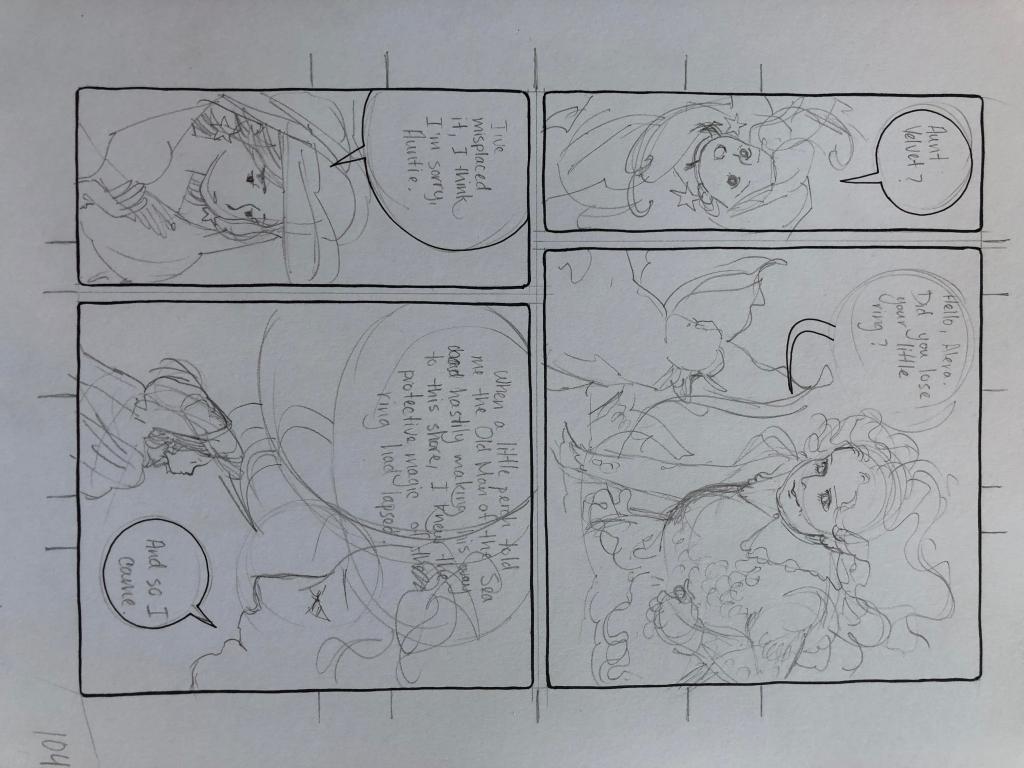
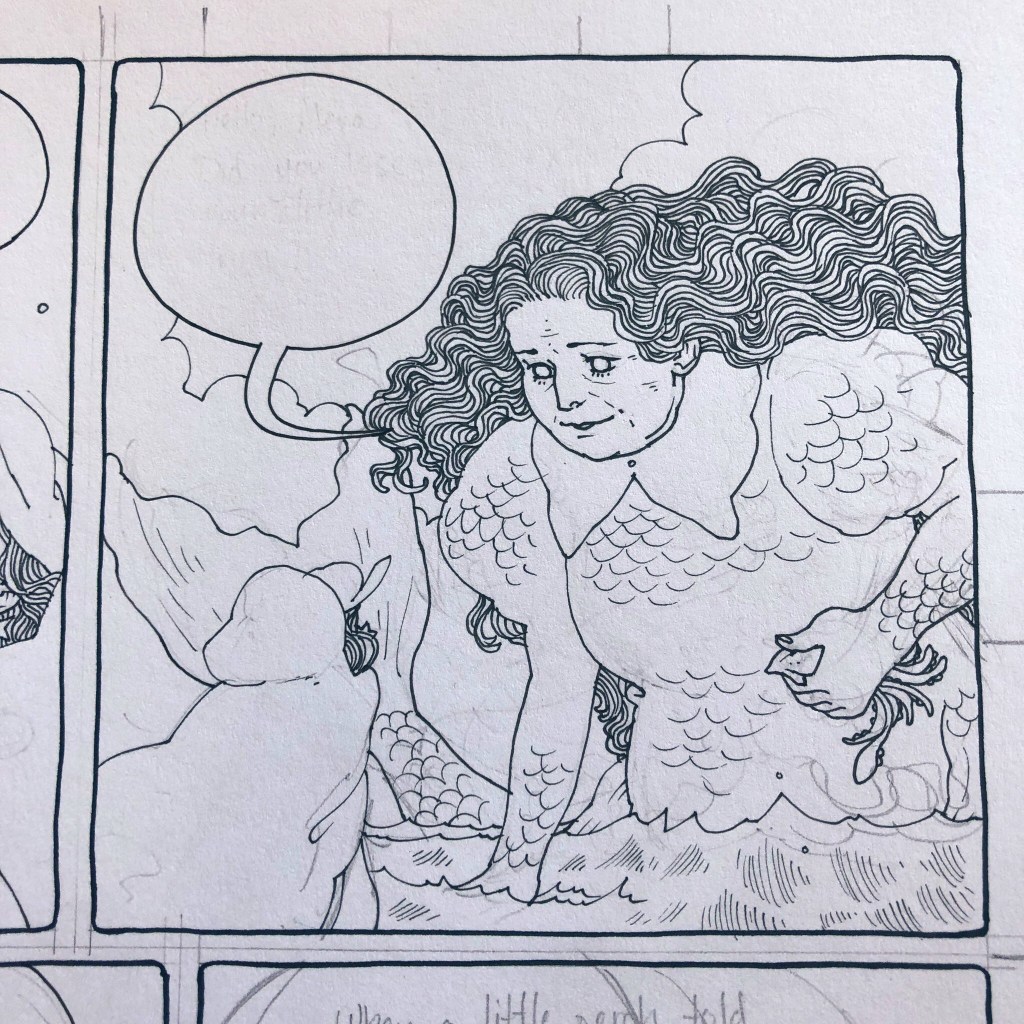
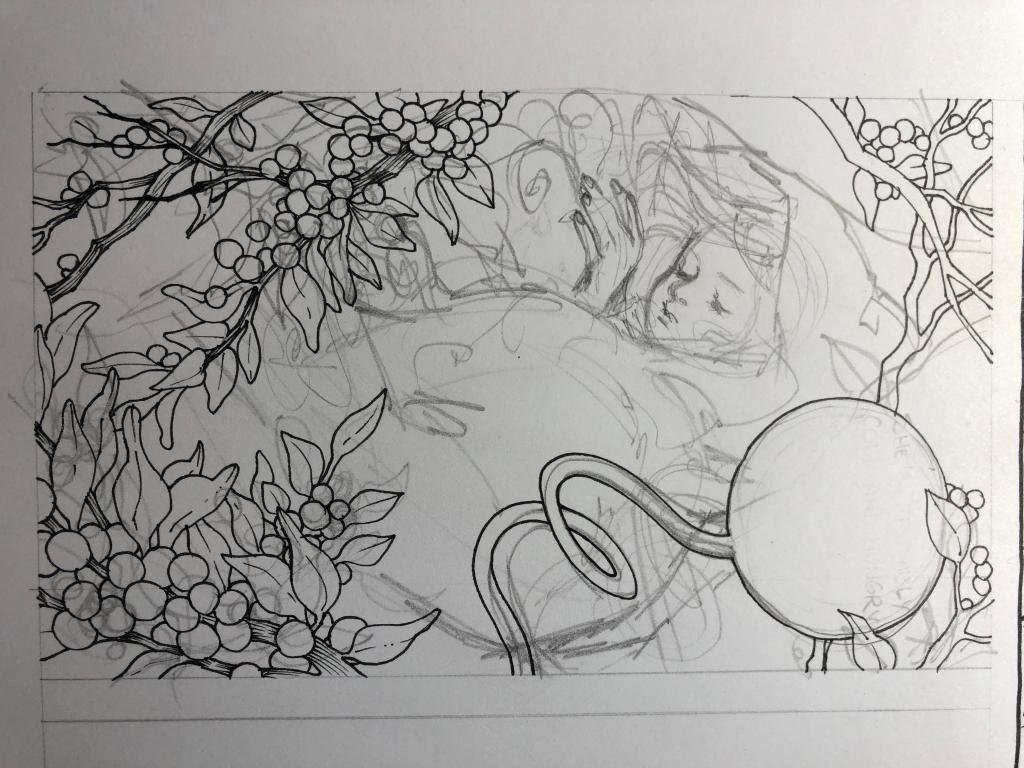
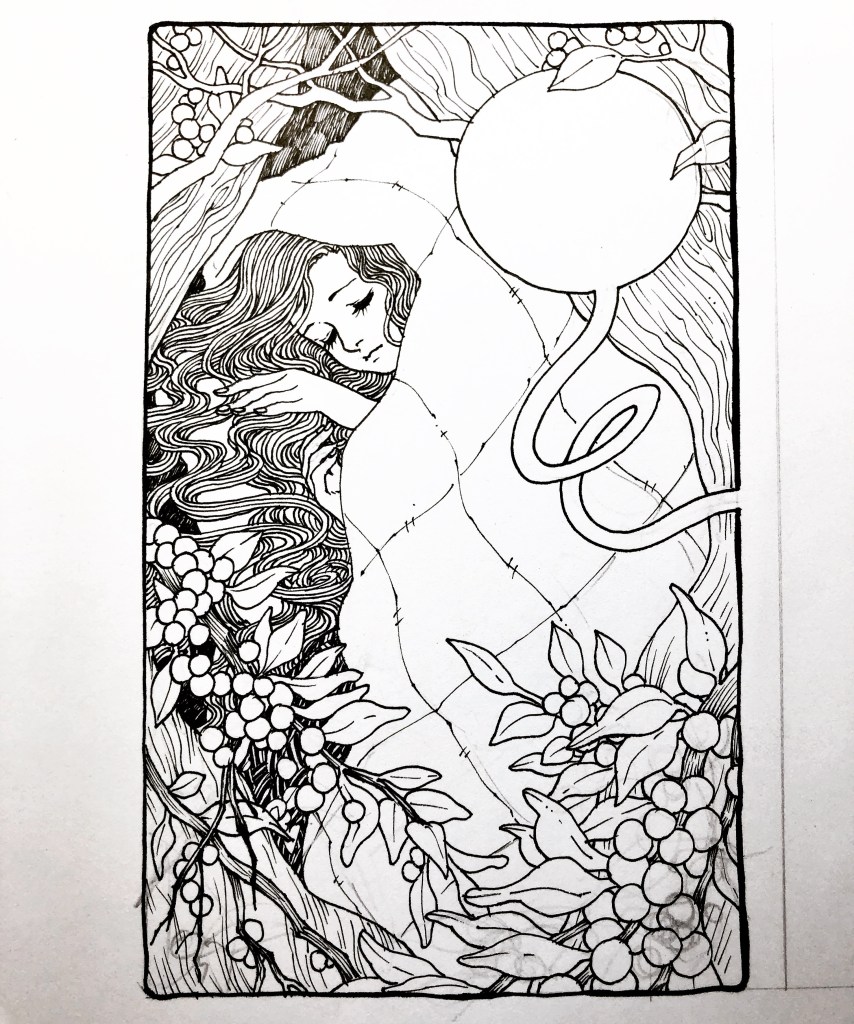
These days, my work is mostly digital. I like to draw on an iPad in Clip Studio Paint. For The Magic Fish, I started with traditional media, though nothing too fancy. A lot of the book is drawn on smooth, card stock paper from your average office supply store. I use a light mechanical pencil to plan the pages, and I ink over that in Micron fine-liner pens, the most professional drawing utensil I have.
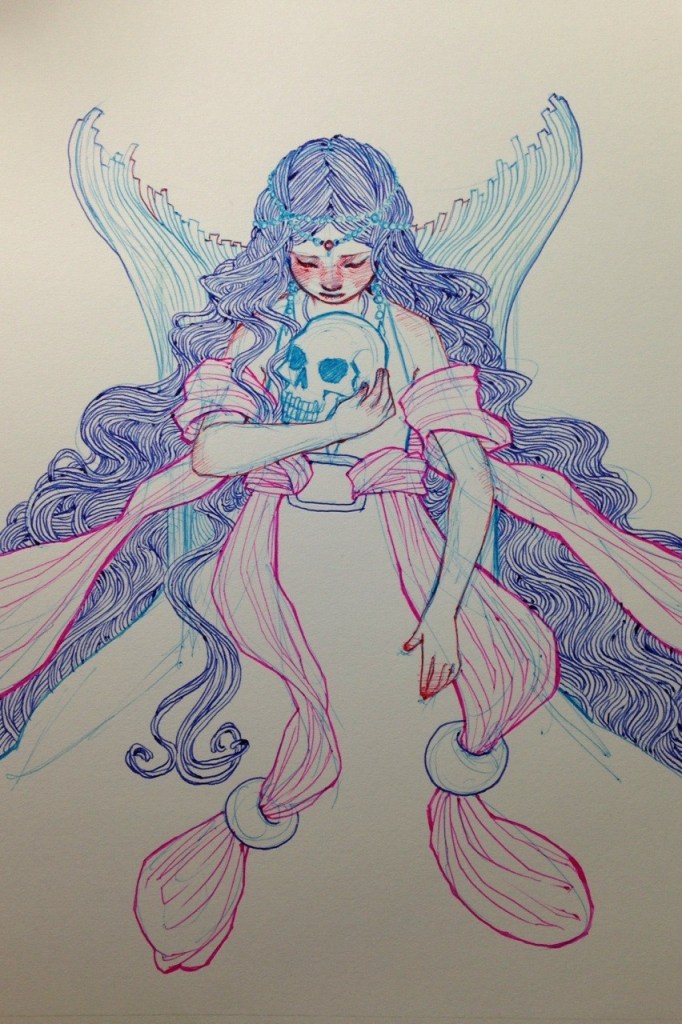
I also have a love of using just standard ballpoint office pens. I occasionally like to use very light blue ballpoint pens to sketch, then I go over it in a red pen, and then I draw the lines in a darker pen, like a dark blue or a black pen.
I very much appreciated how you reveal the darker side of fairy tales throughout The Magic Fish. Why was including the more gruesome aspects of these stories significant to the book’s overall narrative?
One of my favourite aspects of fairy tales is its whole campfire-story vibe. A lot of these stories are oral tradition made to thrill and entertain people of all ages, and sometimes shock factors into that story-sharing experience. I sort of think creepypasta internet memes are actually quite close cousins to the fairy tale as we think of it, and I’m confident most people understand this about fairy tales. We sometimes talk about the Disneyfication of these old stories, the broken fragments of a glass slipper sanded down into harmless beads, but I think most people know that the old tales are different and darker. And it’s sort of a dream-logic, right? For people who occupy marginalized identities, it’s difficult to see or articulate the precise ways systems and institutions affect our lives, so that nightmare imagery that pervades fairy tales can really get at the unknowably horrible feeling that our lives might seismically shift at any moment because of legislation we have no hand in. We’re sort of infantilized in that way. It’s the same sort of fear children experience. What terrible, unknowable things happen in the world of adults that might change your life forever at those early stages when the next bad thing that happens to you is literally the worst thing you’ve ever weathered? It’s not really complex or deep. I think the darkest threads in fairy tales just make sense to the part of us that is afraid.
The Magic Fish is told in three main colours: purple, red, and yellow. Can you speak a bit about the significance of colour in visual storytelling, and why you chose these three specific colours?
It’s a practical consideration. I pitched the book in black and white, but American publishers don’t seem to think black and white comics sell, in spite of manga outselling just about everything. I compromised with my editors and we decided I could work in a limited palette, and then we realized we could use the colors to help orient the readers when a setting changed. The yellow-browns indicate the past, the pinks and reds indicate the present, and the blues and purples represent the world of bedtime stories. Yellow for the morning, red for the day, and blue for the evening.
If you could give one piece of advice to emerging creators trying to navigate the publishing industry, what would it be?
Oh I have not one blesséd clue. I started three years ago, and things change so fast that any advice I had then would be completely irrelevant now. My whole experience in publishing has been during the pandemic. I also occupy a weird space in that I come from comics, but I’m published by an imprint of Penguin Random House, so I’m still not entirely certain of the place comics and graphic novels occupy in traditional publishing. I’m also navigating a lot of this by the grace of my very patient and fantastic agent, Kate McKean, so maybe get a good agent if you can manage. In very general, I think new creators could benefit a lot from networking laterally and supporting their peers in their generational, creative, or professional cohorts as they come up through the industry together.


 YOUNG ADULTING