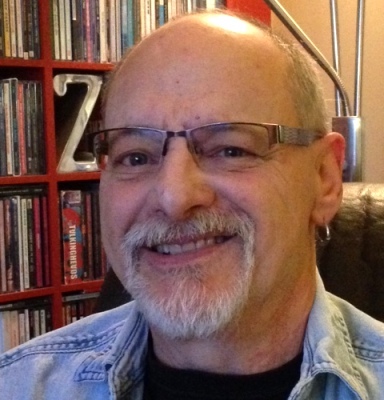
Richard Stevenson was born in Victoria and lived there until he was 28, when a teaching career took him to Nigeria, Vancouver, Lethbridge, and retirement in Nanaimo. He has published extensively, and has several books in his Cryptid, ET, and Fortean lore series forthcoming, including a trilogy, Cryptid Shindig: A Big Book of Creeps and Critters, An Abominable Swamp Slob Named Bob, Hairy Hullabaloo, and Eye to Eye with My Octopi.
Hi Richard! Thank you so much for taking the time to join us here at Young Adulting today. We’re so excited to have you! You’ve published up to 41 books, with your newest and upcoming releases being collections of middle-grade and YA poetry. Can you tell us a bit about what led you to write poetry for younger audiences?
The short answer is having kids! 😉 My son Christian was born in 1975; didn’t manage to publish a novel for middle grade kids until he was a young man, but that started me on my course. Next, was a class with Sue Ann Alderson during my MFA, during which I wrote a few silly monster poems that eventually led to the cryptid critter series, ten-books strong now. 😊
As a kid, I was a collector: of feathers, rocks and minerals, fossils, fish and pets, books. Originally decided to work with the evolving legends and mythos of cryptozoology, ET and Fortean lore, the unexplained, often from the POV of creatures that would as soon slip Linnaeus’ system of genus and species nomenclature; avoid the worst monster on the planet, homo sapiens, for all the usual environmental reasons. Stay away from the top predator! I had my theme; away I went… .
How did your experience in the UBC Creative Writing MFA program impact your writing career? Do you have any tips for students currently enrolled—or planning to enrol—in a Creative Writing MFA?
The MFA years had a huge impact on my writing. Thanks to the experience of a Nigerian teaching sojourn in Maiduguri, Borno State, Nigeria and the decision to put off the MFA until I had something unique to offer by way of experience and craft. It got me over the hump of magazine and litmag publishing to a first and second book and beyond; from literary poetry, to spec kidlit, and hakai: quite a ride, so far. 😊
As far as recommendations go with the MFA, I’d say it pays the most dividends if you wait – not until you are middle-aged necessarily, but until you think you’ve got a handle on the chops and something urgent to say maybe… . If you are in the program, I’d pass on my mentor George Mc Whirter’s advice: when you get good at something, do something else. 😉
Two of your newest poetry books, Eye to Eye with My Octopi and Dark Watchers, incorporate cryptozoology or the study of animals whose existence is disputed (i.e., Big Foot, the Loch Ness Monster, etc.). What draws you to this theme?
The mess humans have made of the Anthropocene so far: from the extinction of species to the destruction of arable land, and water pollution… You name it: we’re clearly the worst monster on the planet. I already had a long fascination with dinosaurs; later, Sasquatch and Ogopogo tales. I eventually found the Wiki cryptid site and started composing monologues in the imagined voices of my imagined critters. I used location detail sightings reports, cryptozoological tomes to nail down a suitable diction: used contemporary teen or tween diction where I could, created local citizens voices to report on the event or creature, or the imagined creature to state its rationale for making the species nomenclature slip.
I got downright encyclopedic in exploring this world-wide monster legend-building mythos. The two collections you’ve mentioned; the earlier volumes, Why Were All the Werewolves Men? Nothing Definite Yeti, and Take Me To Your Leader!… Forthcoming volumes Cryptid Shindig (a trilogy!), An Abominable Swamp Slob Named Bob, Hairy Hullabaloo, will be out in 2023/24.
Finally, I’m back to dinosaurs come November with Dino Dang Doodle and currently back to adult literary fare and haikai poetry.
How does writing poetry impact the way you experience the world? And what do you hope young audiences take away from your work?
I’d like to say writing poetry keeps me sane, but maybe it only keeps me regular. 😊
One of the things I love about my principal genre is that it’s not very commercial. You can’t give it away; therefore, you can go anywhere you want with it! The poetry novel for tweens, teens, even adults is currently in vogue, and I heartily endorse that avenue.
Because I’ve taught for many years, often sixty hours a week with meetings and six classes a semester, I haven’t been able to tour as often as I’d like. On the other hand, it’s kept me grounded in a non-egoistic existence for better than thirty years!
What I hope readers will take away from the kidlit is a sense of wit and humour; the urgent need to de-center the cosmos on the strictly human need; a respect for the tiniest or largest of otherworldly environments we’re fortunate to share with so many different species; a sense of necessary stewardship among sentient hominids, races, cultures, values. Most importantly, an ability to laugh at and be horrified by human (economic) endeavour. We have a smaller brain case than Neanderthals had. They lived through an ice age or two; we twiddle our swizzle sticks and twirl ice cubes in a glass in high rise towers that allow us to see everything but our navels.
What children’s, middle-grade, or YA poets do you recommend?
Oh, there are so many good ones! Amongst the oldies and greats, Dennis Lee, Jack Prelutsky, Margaret Atwood, Shel Silverstein, Jane Yolen, Susan Musgrave, Linda Rogers, Lois Simmie, Robert Priest, Roald Dahl, XJ Kennedy… ;for haiku and scifaiku, and concrete, speclit poetry, George Swede, LeRoy Gorman, LeRoy Gorman (especially Goodwill Galaxy Hunting)
 YOUNG ADULTING