Review by Carolina Leyton
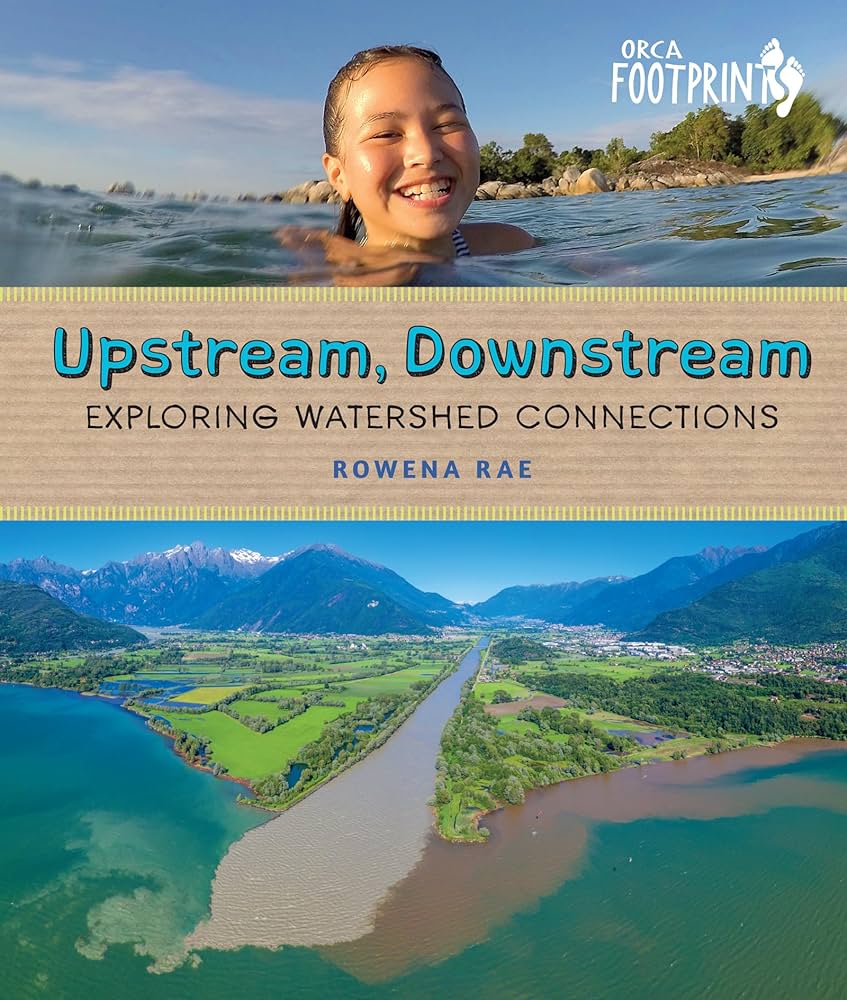
Orca Book Publishers, 2021
48 pages. Hardcover. CAD $18.99. 9781459823921
Middle Grade, Ages 9-12
Non-fiction, Science/Nature
When this precipitation falls on land, it enters a watershed. Whatever is on the land affects a water droplet’s journey through the water cycle. Depending on where it falls, the droplet could stay frozen as snow for a short while, or it could get compacted into a glacier and stay frozen for a long time. Or it could flow into a river, lake, or wetland. There the droplet could be drunk by an animal. It could evaporate right back into the atmosphere. It could soak into the ground and be drawn up by the roots and later released from the plant’s leaves in the process of transpiration.
It’s easy not to question all the environmental changes that had to happen for us to have a house and tap water!
Do you know your watershed address? Mine is English Bay, Burrard Inlet. A watershed is not only the water from a high point that falls down mountains and into the land, but it is also the land through which that water runs. Upstream, Downstream is a unique and important non-fiction, middle-grade book that talks about water and its bodies in a way that makes it abundantly clear that all life on earth is interconnected and interdependent.
Rowena Rae, a biologist by title, makes scientific and historical knowledge accessible and interesting for younger audiences, as well as for adult audiences not trained in science. She starts the book with her watershed address, explaining why this topic is important to all of us. Throughout the book there are moments in the margin called “My Watery World,” adding to how personable the narration is. The book flows (a water pun, like Rae’s!) seamlessly through the history of humankind, how watersheds and waterbodies work, and how humans have effectively changed the constitution of the environment, more often than not, for the worse.
At no point is Rae admonishing, despite the fact that the environmental crisis we are living in might demand it. Instead, she provides the reader with the base information of how water bodies work and then speaks to the ways in which humans have manipulated these ecosystems—through dams, systems of irrigation, among others—and the negative effects this has had not only the environment, but also on particular groups of people.
The book ends on a hopeful note with a few stories of watershed warriors. The activists featured understand that taking care of watersheds is taking care of each other; they have found in nature’s systems and in ancient practices ways in which humans can co-create a better life with the environment. All this said, since Rae’s work is so deeply rooted in the land, it would have enriched the text had she sought collaboration with the many Indigenous communities who continue to practice and live by the principles of interconnectedness that Upstream, Downstream tries to impress upon readers.
This book pulls you in like a soft current and helps you navigate the introduction to a topic as vast as the ocean, ultimately leaving us with a sense of responsibility to at the very least know what our watershed address is. If Upstream, Downstream was given to me instead of a science textbook, biology class would have been extremely fun.
Carolina Leyton is completing her thesis for the Children’s Literature Masters. She completed her BA Honours in UBC Okanagan. From the age of 9, she has been an avid reader and writer, and now hopes to become an author of critical, important, and unique YA novels.
 YOUNG ADULTING