Review by Jacqueline Thomas
Penguin Random House of Canada, 2024
22 pages, 24.99 CAD, 9780735267329
Picture Book, Ages 7-9
Fiction
As a scientist, I can tell you that there is a much more efficient way to write this story. How
many times did the pigs say, “not by the hair of my chinny- chin-chin”? How many times did
the wolf huff and puff? How many times did the wolf try to trick the little pigs? The author of
this fairy tale could have saved their pen ink and written: REPEAT x3. Or created a LOOP
like we do in coding.
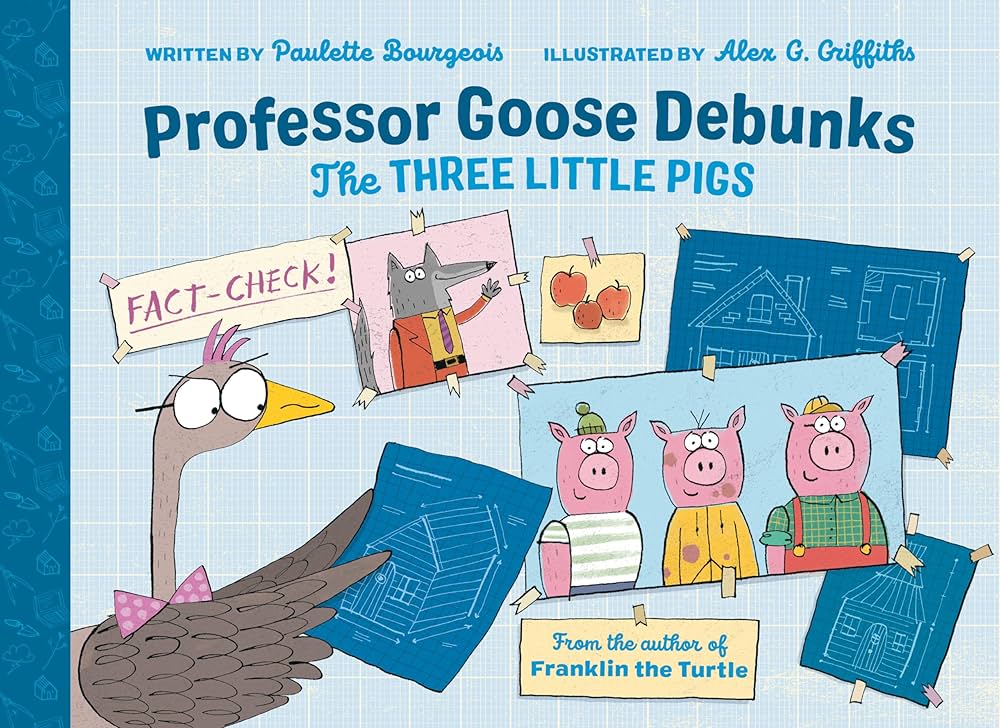
Professor Marie Curious Goose was shocked to find that when her Great Aunt Mother Goose
told the fairy tale, “The Three Little Pigs,” she did not do any sort of scientific research to
make sure her story was sound. So, Professor Goose decides to do her own checks, making
sure the readers know the real story about the wolves and pigs. She introduces the reader to
zoology, meteorology, the rules of architecture, and even some basic coding. She even, based
on her findings and excellent background knowledge, suggests her own ending to the story.
Professor Goose is the stand-out character of the book. She is funny for both kids and adults,
is always positive, and clearly executes her goal of making sure her aunt’s tale is scientifically
sound. She is clearly full of knowledge and shifts the focus away from the well-known story
to herself and her scientific tidbits. The longer stretches where she does not jump in to correct
something builds the anticipation for when she finally does pop up.
My only critique would be that the tidbits professor goose shares are a bit all over the place
and she never gets into enough detail for the reader to fully understand what she is talking
about unless they are already familiar with the concepts. There are a lot of different topics
brought up that get covered in different years of elementary school. For example, coding and
meteorology are often explained in the upper primary years compared to the states of matter
which are a bit earlier. To have them all in one book which has a younger target audience
could make it hard to market. That being said, there are lots of little up and coming scientists
who would love this book for the little tastes of each of these fields.
Overall, I think this is a wonderful STEM spin on a well-loved classic and I hope it will help
inspire some young scientists to do their own further learning about a variety of very cool
topics.
Jacqueline is a first year psychology student at UBC. She loves books and you will often find her daydreaming about the next book she wants to write rather than doing her work. She loves to dance, go paddle boarding and hang out with her cat (and her friends).
 YOUNG ADULTING