Interview by Hannah Luppe
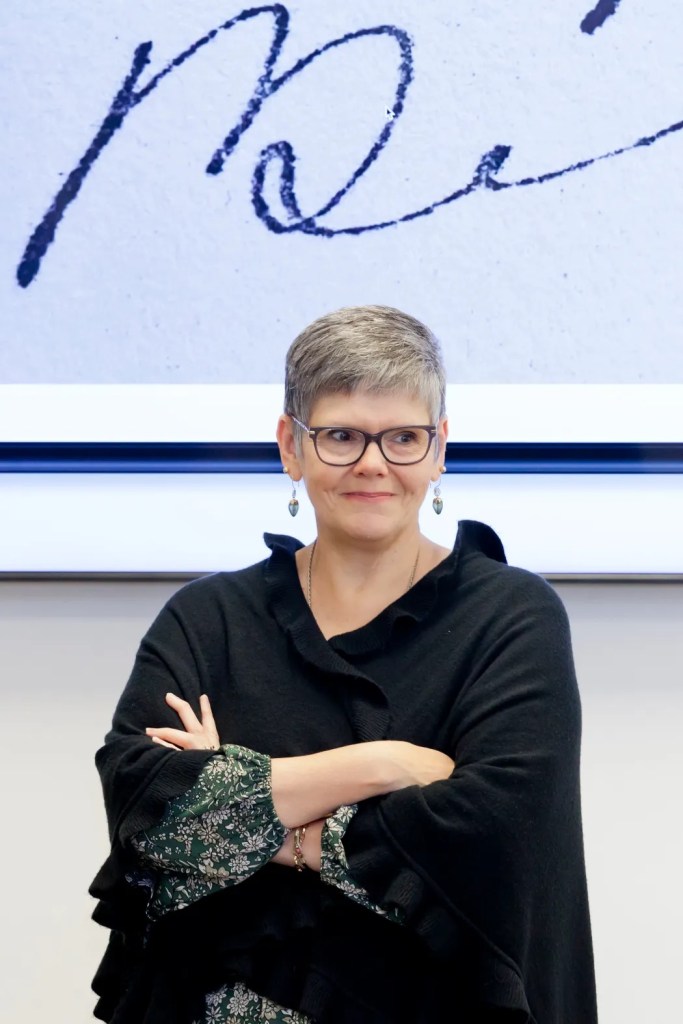
Emily De Angelis comes from a long line of visual artists, musicians, and storytellers. She was born in Sudbury, Ontario where she lived and taught special needs students for 30 years. A graduate of the Humber School of Writing, her western and Japanese-style poems as well as short stories have been published in various anthologies. She has also curated an exhibit of ekphrastic poetry based on the work of Canadian painter Florence Carlyle. The Stones of Burren Bay (Latitude 46 Publishing) is her debut YA novel. Emily now lives in Woodstock, Ontario with her husband while spending summers on Manitoulin Island.
Hi Emily! Thanks so much for taking the time to answer some questions today. We are so excited to have you! Throughout your career, you’ve been an active member of the Canadian literary community, with publications in various anthologies, as well as your recently published YA novel The Stones of Burren Bay. What drew you to writing for younger audiences?
I really became interested in writing for younger audiences after I got my first job as a Children/YA Librarian in Toronto. I discovered that I absolutely loved children’s literature from baby books to young adult novels. I was immersed in both the children/YA literature and the amazing community that surrounds the reading and writing of it. The more I read, the more interested I became in writing for youth. Early on in my writing career, I wrote a couple of picture book manuscripts as well as a series of short stories that are middle grade. However it was YA fiction that really captured my interest. I am certain that there was, at least initially, a nostalgia that drew me to the books of my youth, but once I was fully involved in the field there were specific aspects of YA books that drew me. I was attracted to stories where the characters were immersed in a fundamental journey toward who they were to become as adults. No other form of fiction is as compelling. Young adult fiction, because it must be told from a youth perspective, includes the strong emotional content of the teen, coming-of-age years. This strong, sometimes melodramatic emotional angst and energy appealed to my poetic, lyrical voice. I also wanted to write about difficult topics without sensible, knowledgeable adult voices interfering with my characters’ emotional responses and decisions. As I wrote and continued to read books for teens, I discovered that YA fiction had a huge crossover appeal, attracting adults as much as youth and spanning across all genres and perspectives. Today, I continue to read a ton of YA fiction. I love the diversity of story and perspective.
The Stones of Burren Bay combines magical realism with Irish Celtic spiritualism. Can you tell us a bit about your worldbuilding process? What inspired you to write Norie’s story through the lens of magical realism?
The beauty of magical realism is that the ‘extra-ordinary’ is woven into an already existing or familiar ‘ordinary’ world or landscape. In the case of, The Stones of Burren Bay, Irish Celtic spiritualism is woven through Norie’s contemporary story like a thread of gold through a large bolt of familiar fabric. The speculative component is subtle, but it shines through when the light of story and setting hits it. There is a world we are all familiar with here, either through lived experience, media or entertainment—deadbeat fathers, distant mothers, isolation at school, teenage angst, self-identity, religious practice and belief, trauma. These things do not require worldbuilding at all. They are part of the story that needs telling, but some basic assumptions can be made by both writer and reader about how the characters exist in this normal, everyday, modern world. Even the historic life of Oonagh, the protagonist Norie’s spirit guide, has some familiarity to it, especially if we have studied early, Canadian, settler and indigenous histories. It is the merging of Norie’s modern life with Oonagh’s spiritual existence that is magical and extra-ordinary. I knew that setting the novel on Manitoulin Island or Spirit Island, as it is called, would be a perfect fit for this kind of spiritual experience. The Island has been home to the Anishinaabe people for centuries, long before white settlers arrived. When you’re there, it’s clear that it’s a place steeped in spirit and sacredness. This divine atmosphere makes you take a deep breath and relax into the otherworldliness of the landscape. The ancient rock formations of the Island, the rock of the Niagara Escarpment, allow readers to feel the historic power of the other realm through the very rock on which the story takes place—a geography shared by the fictional village of Burren Bay and the very real Burren in County Clare, Ireland. In the end, my world building focusses on creating links between the past and present and the emotional connections between landscape and spirit.
What is your favourite part of the writing process?
I used to be quite enamoured with the final product of the writing process: the finished story, the poem ready to share, the completed manuscript. However, I got to the point where I could barely write a line or sentence without over editing myself, writing and rewriting. I now know that while completion of a project is the end goal and must happen, it is the working together of the various parts of the story machine that excites me. I am the perfect balance between a plotter and a pantser. I spend a lot of time on a project planning and thinking before any words are written on the page. I love to research but have learned not go down the rabbit hole of over researching. I’ve learned to be very specific about the information I need for the story. I have a schematic of the plot and various character and setting notes done ahead of time. I make myself write one continuous draft without revising or editing as much as possible. I keep a small notebook beside me to write down a kind of running record of the things I want to add or change later. Once the first draft is complete, I love layering in new scenes or chapters, additional character actions and thoughts, new plot points that make the story richer and more exciting, or setting enhancements like weather and time of day. I have given myself permission to not write perfectly right off the bat, because writing is a process not an action.
As a children’s librarian, educator, and storyteller of both written and oral tales, how has your relationship to storytelling impacted the way you see the world?
Story is the great equalizer. Everyone, absolutely everyone, has a story. It might be a story about immigration. It might be a story about a long-lost ancestor. It might be a story of the death of a parent or sibling, or illness and addiction, grief or guilt. It might be a funny story about what happened yesterday at the grocery store. It doesn’t really matter what the content of the story is. Instead it is coming to believe that regardless of content, religious affiliation, gender identity, ability, culture or race, story is what makes us uniquely human and therefore the same. Story also builds empathy and compassion in both children and adults. As Margret Atwood has said, “in the end, we’ll all become stories.”
Are there any memorable words of encouragement that have stuck with you throughout the publishing process that you could pass on to emerging writers?
As a student of linguistics and symbolic anthropology, I am a big believer in the power of words and mantras. Every January I select a NorthStar Word that guides me through the coming year. Last year the word was ‘unfurl’. This year my NorthStar word is ‘audacity’. I also like to pick out words and phrases from other writers during workshops, courses, panels and readings and post them on a bulletin board above my desk. Two phrases that have stuck with me my whole writing life and definitely throughout the publishing process are:
- Write Crap: None of us is able to produce perfection in the first attempt at anything. But if you do not attempt it and embrace the difficulties and perhaps failures, you will never complete a thing. Write crap and then massage, prettify, perfect it once you have the base to work from. Thank you Gail Anderson-Dargatz.
- Leap and Net Will Appear: Have faith. Have faith in yourself, your abilities and your capacity to learn craft. Have faith in the process. Have faith in the other professionals who are critiquing or editing your work. They only have the best in mind for your project. Learn to listen and believe in their intentions and abilities and then take that leap. Thank you Claire MacKay.
For extra content, our managing editor chatted with Emily over on your YouTube Channel!
 YOUNG ADULTING