
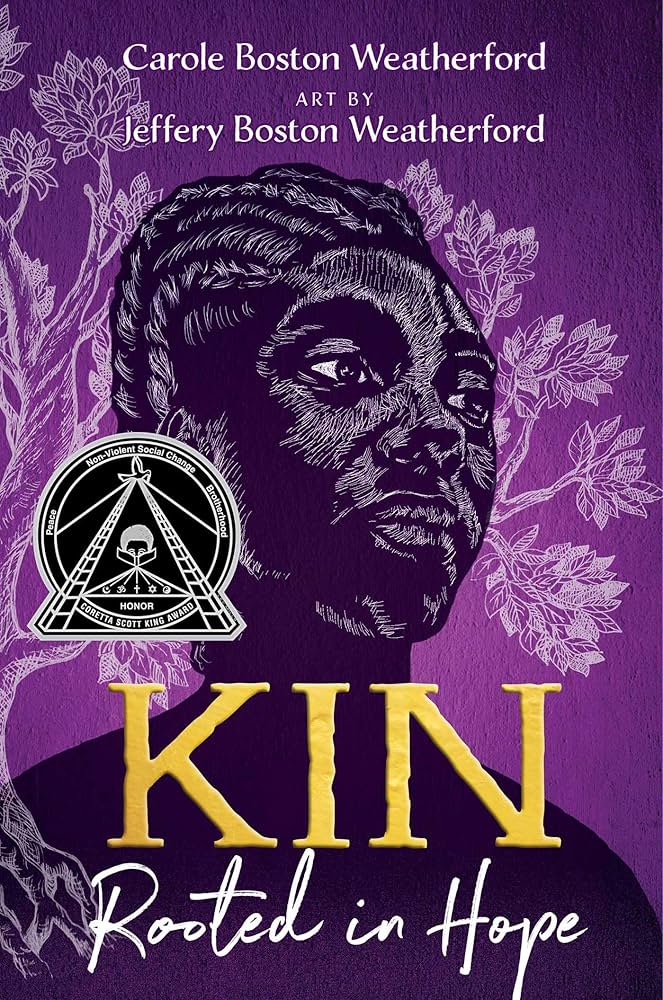
Review by Ella Richards
Simon & Schuster, 2023
202 pages, Paperback, $11.99 CAD, 978-1665913621
Middle Grade, Ages 8-12
Poetry, Historical Fiction
Before the Boston Tea Party protested
Taxation without representation
I was training to serve exotic teas In porcelain cups and saucers.
Before the First Continental Congress convened and Patrick Henry proclaimed,
“Give me liberty or give me death!”
My childhood had come to an end.
…
Before General George Washington
Crossed the Delaware River. I sat On the banks of the Wye, wondering:
How far to Africa?
Before the Patriots defeated the Redcoats
to free the new republic from the Crown, my royal ties were robbed from me.
But Africa drummed in my heart.
How can you trace your ancestry when your family tree has been torn down time and time again?
Black American poet Carole Boston Weatherford is determined to rebuild her family history after decades of sanitization and erasure from records and history books. In a seamless blend of autobiographical truths and speculative reimaginings of her ancestors’ own lives, Weatherford reclaims stolen history in this poignant collection of poetry for young readers. The story is told from the perspectives of five generations of her own autobiographical ancestors, from days of African royalty, to the horrors of enslavement in the United States, and finally— to freedom.
Reading Kin: Rooted in Hope, is like reading a map. Each poem feels like a place, a fully fleshed out, discoverable piece of a greater world that the text is developing. Weatherford takes full creative liberty in regards to her family’s history, choosing to personify every element of that past. There are poems told from the perspective of geographical features like bays and ports, slave ships, and even plantations themselves. One of the most striking poems in the text is told from the perspective of two statues, one of Frederick Douglass, and the other of a common Confederate soldier. The unique structure of this poem allowed for the narrator to orchestrate a conversation between these two inanimate statues and the ideals they represent. This, to me, truly encapsulates the biggest strength of Weatherford’s writing: her capacity to reanimate and question history previously thought to be set in stone. These poems in particular aid in the understanding that slavery was not just found in the actions and interactions between people, but is deeply rooted in the systems and the history of the United States.
Apart from the personification, many of the text’s poems are told from the perspective of Weatherford’s enslaved ancestors. This takes the already deeply moving text and makes it even more personal and honest. Each one of her ancestors comes to life through their respective poems, with their own voices, wants, and beliefs. In this, the picture of Weatherford’s family feels whole and complete. Weatherford shares earnestly what she both knows and imagines to be her family’s thoughts and experiences, urging the reader to connect and empathize deeply with the text’s characters.
The text functions excellently for young readers, providing a truthful and complete representation of slavery for its middle grade audience. Rather than taking an impersonal, didactic approach, the text imparts historical information and education in a way that encourages emotion, empathy, and reflection. As Weatherford reimagines her personal family history, Kin: Rooted in Hope reimagines what it really means to learn about and understand the past.
Ella Richards is an undergraduate student studying English Literature in UBC’s Honours Program born and raised in Las Vegas, Nevada. When they aren’t curled up with a good book, you can find them performing with UBC Improv, watercolouring, or experimenting in the kitchen.
 YOUNG ADULTING