
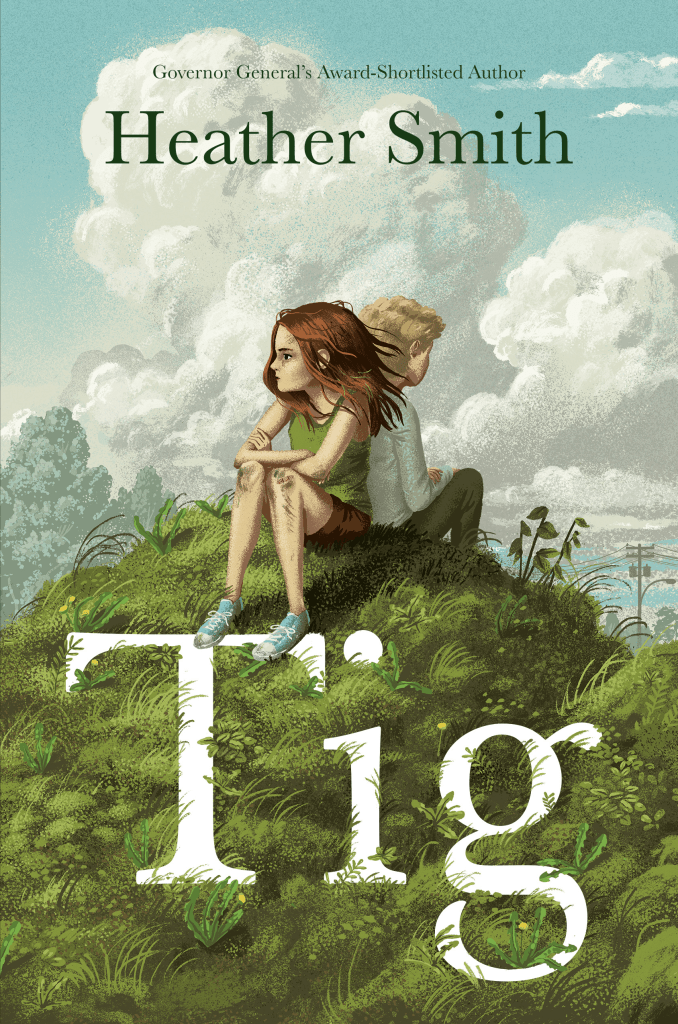
Review by Yanya Bhatia
Tundra Books, September 2024
160 pages, Hardcover, $23.99 CAD, 9780735267497
Middle Grade, Ages 9+
Fiction, Contemporary Realism
I think that was the moment Peter changed. He dissolved. Melted away. He was powdered coffee and they were hot water. They poured over him until he disappeared.
[…]
To be honest, part of me wanted to be back at the old house where the only thing in the cupboard was a jar of Nescafé. When you have nothing, you know who you are. When you have a grilled cheese, you’re not sure.
Heather Smith’s Tig unfolds with the poignant delicacy of a butterfly emerging from its cocoon, revealing layers of emotion and resilience that resonate deeply with readers. Set against the backdrop of upheaval and adjustment, Tig and Peter’s journey from a life without electricity and parents to their Uncle Scott and Manny’s home is a testament to the human spirit’s capacity for adaptation and growth.
From the outset, Smith immerses readers in Tig’s world, where every emotion, from anger to vulnerability, is palpable. Tig’s narrative voice, conveyed with a rapid-fire, almost breathless pacing, mirrors her turbulent inner landscape. Her coping mechanisms, like planning to become a competitive cheese racer, are both whimsical and poignant, reflecting her desperate attempt to assert control in a world that has left her feeling adrift.
Smith excels in character development, particularly in her portrayal of Tig’s transformation. Initially defensive and resentful, Tig gradually thaws under the patient care of Uncle Scott and the quiet observation of Manny, yet with moments of angst and hate towards the world around her. Each character interaction is rich with nuance, highlighting the complexities of familial dynamics and the slow, steady process of trust-building and acceptance.
Smith skillfully uses analogies to illustrate Tig’s emotional state early in the book, such as Tig feeling like “my tangles ate combs even though they are the ones with teeth,” capturing her sense of frustration and displacement.
Uncle Scott, with his talkative reassurances and well-meaning gestures, contrasts beautifully with Manny’s silent, perceptive presence. Together, they create a stable environment that gradually softens Tig’s rough edges, even as she continues to test their boundaries with acts of rebellion. The poignant scene where Tig smashes the television, a symbolic act of defiance and grief, underscores her struggle to reconcile her past with her present reality.
Smith’s prose is evocative, using vivid imagery and metaphorical language to paint a picture of Tig’s inner turmoil and external environment. Scenes like Tig’s visceral reaction to her new home’s perfection, “Everything in this house is fake. Even this tea” is as if she’s waiting for a facade to fall down.
The emotional core of Tig lies in its exploration of identity and belonging. Tig’s journey towards healing is not linear; it’s a messy, unpredictable path marked by setbacks and small victories. Her struggles with anger and grief are portrayed with unflinching honesty, offering young readers a mirror to their own complex emotions and a beacon of hope that healing is possible, even in the midst of chaos.
At its heart, Tig is a story of resilience and the transformative power of love. It’s about learning to let go of the past and embrace the possibilities of the present. Through Tig’s eyes, readers experience the profound truth that family isn’t always defined by blood, but by the bonds of understanding and acceptance forged through shared experiences. With its richly drawn characters and poignant narrative, Tig is a must-read for middle-grade readers seeking stories that resonate long after the final page is turned.
Yanya Bhatia is an undergraduate student majoring in Psychology at UBC. You can find her buried deep in a book, exploring old bookstores, listening to music or baking.
 YOUNG ADULTING