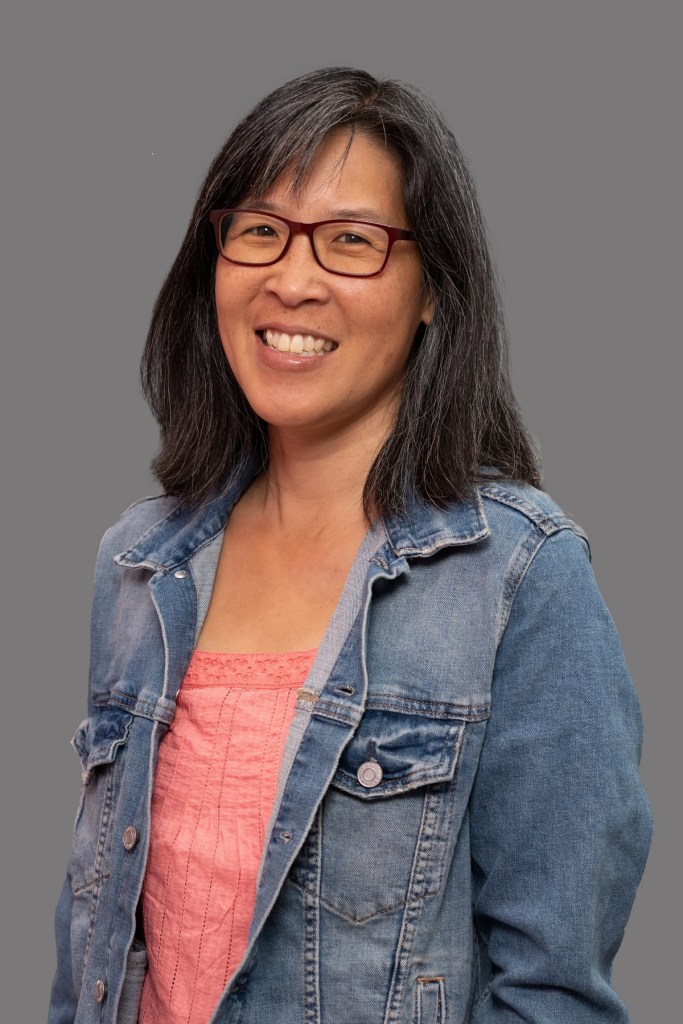
Michelle Wang (she/her) is the author of a series of picture books about a fun loving family discovering the beauty of the changing seasons: It Must Be Autumn (winner of the 2021 Royal Dragonfly Book Award and the Southern California Book Festival Award), It Must Be Winter (2021 Wishing Shelf Book Awards finalist), It Must Be Spring (2023 Educators Choice Awards finalist), and It Must Be Summer (available December 2023). Michelle lives in Toronto, Ontario, where she was born and raised on Saturday mornings at the library with her two sisters, borrowing ten books each. The rest of the week, she lived in the worlds of heroes whose names were spelled with an e and wore paper bags and ate alligator pies at Macdonald Hall, alongside chums aged two plus two plus two who owned the wrong hockey sweater and told tales of strange things done. When Michelle grew up and got married, her mother-in-law came to stay one day. Things went missing, and the events that ensued inspired Michelle, author of the award-winning series It Must Be Seasons, to write Oma’s Bag as a love letter to her husband and their four children, as well as for all those families who have loved ones living with dementia. Unlike Oma, Michelle doesn’t usually carry around a purse or a bag, but please don’t ask to look in her pockets.
Hi Michelle! Thanks so much for taking the time to answer some questions today. We are so excited to have you! Can you tell us a bit about what drew you to writing for younger audiences?
I have always been drawn to books and writing, and as an elementary school teacher and mother of four children, I read picture books by the armful. But I never thought I’d actually write one myself – that just sort of happened.
For my first book, It Must Be Autumn, I was looking for a fun and engaging story about the signs of the season to read to my grade one students and couldn’t find one. A few weeks later, as if my brain had a mind of its own, suddenly I was scribbling down the words to a fully formed book. After that, the other three books in the series just had to be written, (to complete the set, but also because readers were asking for them.)
With Oma’s Bag, I had just finished publishing It Must Be Winter when my husband’s parents came to live with us. By that point in time, everywhere I looked, events unfolded in front of my eyes as if being told in a picture book. It seemed only natural for me to write this book based on my family’s own experiences.
So, like I said, it just happened. (And in fact, the fate of the next story I’ve written depends on me somehow getting Ryan Reynolds’ attention, so if anyone happens to know how to do that, hit me up please!)
Your newest picture book, Oma’s Bag, is an incredibly touching read meant to help children navigate an Alzheimer’s diagnosis in their family. My own grandmother was diagnosed with Alzheimer’s when I was quite young, and I would’ve loved a picture book like this one. What do you hope readers—both young and old—take away from this book?
To be perfectly honest, Oma’s Bag wasn’t originally written specifically to help children navigate an Alzheimer’s diagnosis in their family. Rather, it was actually my way of trying to help my own family through a particularly challenging time in our lives.
A few years ago, we began noticing Oma, my mother-in-law, becoming increasingly forgetful and confused. One morning, she was wandering around the kitchen turning on this and moving that, asking the same questions over and over again. Opa, who had been watching her quietly for a few minutes, turned to me, eyes brimming, and said, “I feel like she’s slipping away.” At the time, I was wholly unprepared and could only muster an utterly unhelpful “it’ll be okay”.
That moment weighed on me for the next few days; would we really be able to find our way through this? But then as I saw Opa’s sadness contrasted by the laughter and exuberance of my husband and children interacting with Oma, I realized: maybe she wasn’t exactly the same person as before, but this version of Oma was and we could still have fun together and enjoy the stories she loved to tell. We could meet Oma where she was and continue to make beautiful memories with her. Oma’s Bag became the answer I wished I had given my father-in-law that first morning.
The underlying message of Oma’s Bag – that the happiness and love we feel today become the memories we hold onto tomorrow – is one that I hope all readers (whether touched by Alzheimers or not) will take away from this book.
What is your favourite part of the writing process?
The blank page is always so exciting for its’ unlimited possibilities but also daunting to put down that first singular opening word. Crafting the perfect sentence with the exact right combination of feelings, words, and cadence is a bit of magic in itself. To work with an editor making changes I didn’t know I needed to say things I didn’t even know I wanted to say was such an amazing collaborative experience (thanks Laura Bontje, I probably could have used you to edit that last sentence!) But watching or hearing about someone’s reaction to reading my writing for the first time and knowing that they connected with it on any sort of level, well, that probably has to be my favourite part of the writing process.
You mention that Oma’s Bag is a love letter to your family, as well as other families who have loved ones with dementia. How did you navigate writing such a personal story?
Because Oma’s Bag was first and foremost meant as a present for my family, I knew what I wanted to say, where I wanted the story to go, and how I wanted to say it. The cast of characters was my family and the events depicted had actually happened in real life. After the story pretty much wrote itself (as hindsight me recalls), it was so much fun working with my uber-talented illustrator Sam Nunez figuring out everything from dressing the characters in their favourite outfits to which titles to put on the books on the bookshelf. Somewhere along the way came the idea that this might be a story to share with the outside world. The hardest part of the process became trying to honour the truth of my family’s story while making it relatable to a wider audience. It is my sincere hope that our very personal story of a family learning to laugh and love though heartbreak resonates with other families who have loved ones living with dementia.
What other advice or resources might you be able to pass on to someone trying to navigate an Alzheimer’s diagnosis in their family?
The back matter of Oma’s Bag contains some information, tips, and resources about Alzheimer’s and was created in consultation with a leading expert in the field. Dr. Jennifer Ingram was gracious enough to offer her time and suggestions to provide a starting point for families to help navigate their own journeys.
Beyond that, one of the most interesting side effects of writing Oma’s Bag has been being constantly asked my opinion and advice about Alzheimer’s. At first, I felt wildly ill-equipped to answer because I was really only writing from my own personal experience. But as I began talking to more people, it seemed like everyone (yourself included) had their own story to tell about someone in their life affected by this diagnosis. The truth is people just want to share and I am so thankful that Oma’s Bag has inspired people to open up and continue these very important conversations.
Hannah Luppe is currently completing her MA in Children’s Literature at UBC.
 YOUNG ADULTING