
Review by Sumaiya Matin
Tradewind Books, 2024
96 pages, Paperback, $14.95 CAD, 9781990598142
Middle Grade, ages 9-12
Historical Fiction
APIDA
Dark ruins, dark houses with no lights, a deserted street. Moder was asleep on the couch when I stepped in, so I put the naan on the kitchen table and went to my room. But my bed was gone. I went to Moder’s room. Her bed was gone as well.
I rushed over to my sleeping mother. “Moder!” I said, waking her up. “What happened to our beds?”
“I sold them to make money for our trip. We are leaving tonight.”
I was stunned.
I couldn’t imagine living anywhere else. I had lived in that house, on that street, in that neighbourhood, my entire life.
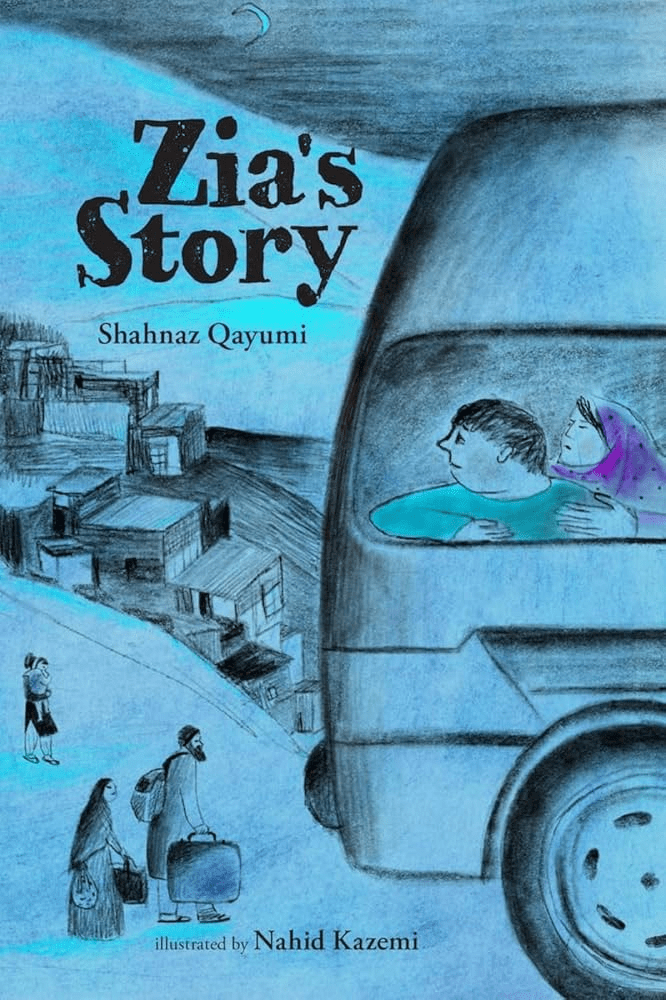
When the Taliban take over Afghanistan in the mid-1900s, Zia, a young Afghani boy is forced to leave the country with his mother for Pakistan, and later, Canada. This story is based on the author Shahnaz Qayumi’s own refugee experience with her son.
With Zia’s father arrested by soldiers and never to be seen again, Zia becomes the ‘man of the house,’ tasked with the responsibility of taking care of his mother. Gone are the days of pursuing hobbies and play such as kite flying. The streets are demolished by violence and many of Zia’s friends disappear. Women such as his mother no longer have the choice to dress how they would like to. They are also not allowed to work or go to school. Increasingly, Zia finds himself taking care of not just his mother, but others in the neighbourhood.
Eventually, he and his mother set out for Pakistan, seeking work and places to live. They face a number of obstacles including loss of their savings, and Zia’s enrollment in a free school which turns out to be a training ground for Taliban suicide bombers. Although strands of hope are followed by disappointments and tragedies, Zia and his mother continue to persevere, holding their cultural traditions and sense of honour dear to their hearts.
Qayum’s storytelling is straightforward and direct. She refrains from exploring the inner terrains of her characters’ minds, or using literary devices to convey the gravity of grief and pain. Instead, she states the facts of the events of their lives using a subdued tone, and that in itself is enough to put readers in the characters’ shoes. The world she builds is grim, one of survival, and readers live it by following Zia and his mother through a series of tribulations that challenge their trust in others. This story exemplifies how one can choose to act from a place of high character despite atrocities and deceit.
The compounded losses experienced by refugees, particularly of one’s home, family and friends, identity, as well as shock, ongoing instability, and chaos, are shared through this story. The reader, a witness to the trauma, may be left with a range of emotions, including awe regarding the resilience refugees often draw on to overcome calamitous circumstances. For this reason, a guide for educators may be helpful to aid follow-up discussions on the topics explored in the book. A child aged 9-12 may certainly be inspired by Zia’s Story, and develop greater empathy for others, as well as some understanding of the global world. However, without context or a container to process their questions and emotions, this book may prove to be a challenge, given the subject matter.
Zia’s Story includes black and white illustrations at the start of each chapter. Although minimalist in design, these illustrations deepen the reader’s understanding of Zia’s life before and after the Taliban takeover, as well as the unfolding of his journey. They capture complex emotions and add texture, similar to the effect Qayumi has achieved by interspersing her native language throughout the text. The cover image boldly emanates a sense of loss and dislocation from what is familiar and dear, but also, the journey that lies ahead. There is an air of impending growth, mirroring Zia’s rather quick transition from boyhood to adulthood.
The richness of this story truly lies in the reality Qayumi boldly exposes, and the sense of honour each character lives by, despite hardship. The fact that the story parallels that of the author makes it all the more powerful.
Sumaiya Matin is the author of the literary coming-of-age memoir The Shaytan Bride: A Bangladeshi Canadian Memoir of Desire and Faith (Toronto: Dundurn Press, 2021). She is currently working toward her Master of Fine Arts (in Creative Writing) at the University of British Columbia. Follow her writing journey @sumaiya.matin
 YOUNG ADULTING