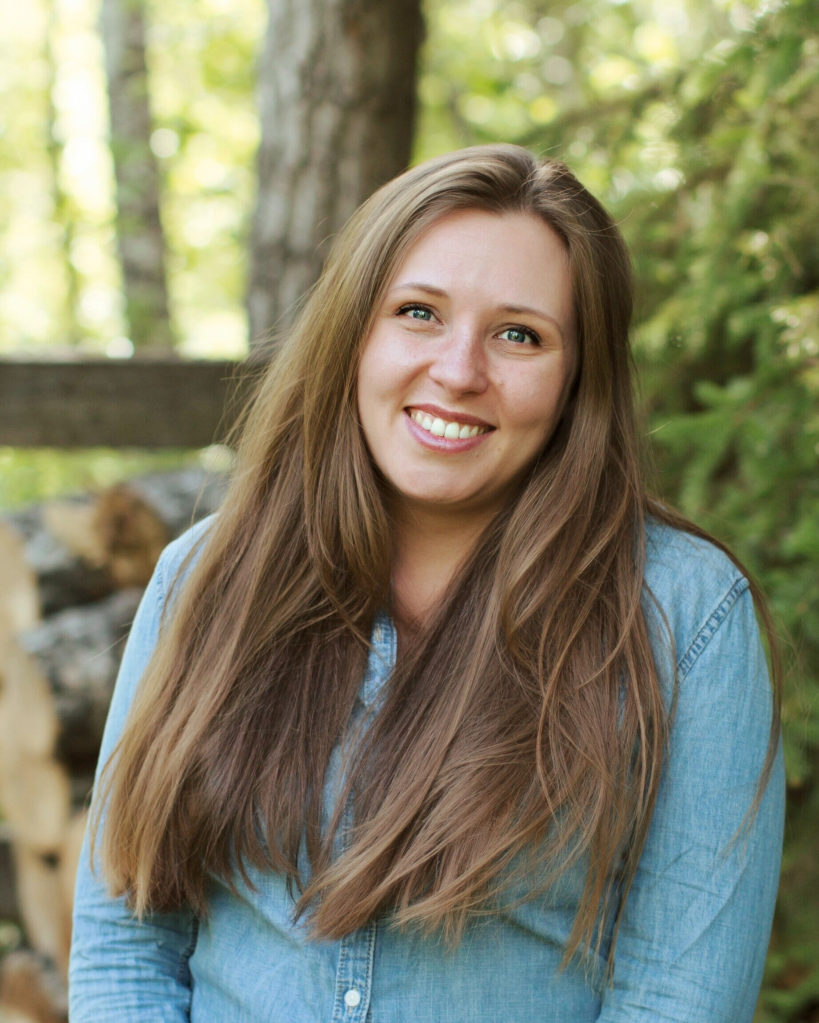
Charis St. Pierre is a graduate student at the University of Alberta studying ecocriticism in Children’s Literature. Her PhD focuses on plant characters in picturebooks. Charis’s first picturebook, Welcome, Dark, was released from Orca Book Publishers in 2022. She lives in Edmonton with her husband and two children.
Thanks for joining us at Young Adulting! Your book, Welcome, Dark is a very touching and gentle tribute to the night time, and I felt that with a shorter word and page count it really relied on the sound and silences in each illustration. What was it like first getting the idea for the book, submitting it, and then being accepted by a publisher?
Welcome, Dark was as a Covid project. My son was three, and had been needing a lot of reassurance at bedtime about the nighttime sounds outside his window. I realized that most of the classic bedtime stories we’d been reading to him focused on making nighttime feel calm and quiet, which wasn’t much help in explaining why the wind and rain sounds wouldn’t go away. So, I found myself trying to explain to him why these scary-seeming sounds were doing important things in the world outside, and I realized the idea could be a good basis for a picturebook.
As this was my first stab at publishing, I didn’t have an agent; I emailed the manuscript to a number of publishers but I wasn’t holding my breath that it would get picked up. And then as the weeks went on, I sort of forgot about it. It was a number of months before Orca Book Publishers contacted me, at which point I was surprised and couldn’t have been more thrilled. They brought the story to life beautifully.
What’s your creative practice like these days? Are there works you’re excited about or planning to publish?
Last year I started a PhD program at the University of Alberta, so I’m sad to say my creative practice has been on the back-burner lately. The exciting part is that I’m doing my PhD in children’s literature, so for the next couple of years I get to study picturebooks like it’s my job. I’ve certainly got lots of themes and ideas brewing as a result of my current studies, which I expect will take form eventually. I find that for me, creative projects tend to come about in a methodical sort of way, as I piece together ideas from my reading and conversations. So, I have no doubt that more stories will take form over the next few years; in the meantime, though, I’m focused on getting through writing a dissertation.
What sort of feedback have you felt surprised by in response to your work?
The feedback I value most on Welcome, Dark is when someone tells me their baby enjoyed it. It’s great when adults appreciate the story, but hearing that someone’s toddler keeps asking for it at bedtime, or enjoys pointing at the cars and bunnies, is the very best praise that a picturebook can get.
You worked with an illustrator on this book as well – what was it like to find the right visual language for the book?
My editor was proactive about inviting me into the illustration process, but I tried to stay pretty hands-off when it came to selecting an artist and letting her do her thing. Seeing Rachel Wada’s interpretation of my poem was an absolute gift. I loved her vision for the book and once I saw it, I couldn’t imagine the story any other way.
Our audience really ranges from students to readers and writers, as well as parents. Do you have any advice for our readers on what makes a book worth reading for you?
One of the gifts of children’s picture books is how interactive and multimodal they are as a medium. The reading that happens between parent and child, or teacher and class, has a rhythm and back-and-forth to it that you just don’t get in other forms of literature. I’ve found that I really love books that lean into those interactive elements, and treat the reading experience as a unique mode of collective storytelling. There’s nothing like an ambiguous illustration or well-placed page-turn to get a reader thinking, and that encounter can become really magical for both children and adults. I’ve realized that those sort of fill-the-gap moments and conversations are what I love about literature generally. And I think picture books are masterful at it.
Nisha Patel is the Poet Laureate Emeritus of the City of Edmonton. An award-winning disabled and queer artist, she is a Canadian Poetry Slam champion and holds a master of arts in cultural studies from Queen’s University. Her second book of poetry, A Fate Worse Than Death is out now with Arsenal Pulp Press. She is a recipient of the Queen’s Platinum Jubilee Medal and the Edmonton Artists’ Trust Fund. She is currently finishing her master of fine arts in creative writing.

 YOUNG ADULTING