
Review by Nisha Patel
Penguin Random House, 2024
48 Pages, Hardcover, $24.99 CAD, 9781774882023
Picture book, ages 4-8
Fiction, Comedy/Humour
And then three strangers appeared.
Their eyes were very big,
their skin was very blue
and their shape was very hard to describe.
“Hello,” said the short one.
“We are DEFINITELY human.”
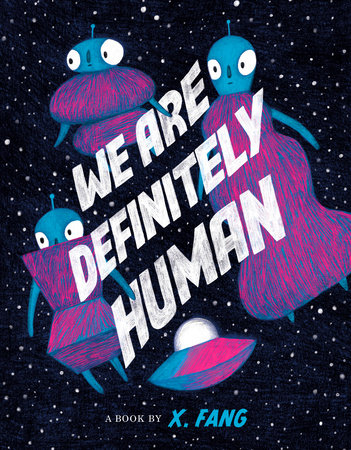
We Are Definitely Human by X. Fang is a whimsical story told in two parts that combine into a final, and more wonderful, whole. First, the words of the story make up a narrative that is straightforward for any young reader: you have three strangers who are stranded at night and are seeking help. It is late, and they are offered shelter and assistance the next day. On the surface this part of the story is about care, kindness, and sharing. But the visual story that makes up the second part is about contrasts: the strangers have become stranded and are seeking help, clumsily approximating human needs and human behaviour, but they are definitely not human. The visuals mix with the narrative to allow the author to let us into a multilayered world where everyone knows the strangers are not human but have them still treated as any human in need would be. The themes of kindness and non-judgmental help are reinforced in novel way, and young readers will find joy and humour in the story as they are let in on it.
The visual language is vibrant, relying on a contrast between the ordinary and familiar neutral colours of the people helping the strangers in browns and yellows, and the blues and purples of the skin and clothing of the aliens. The ship they arrive in matches their colour palette, and they stand out on every page they are on as intended. It builds an additional layer to the unspoken secret from the perspective of the townsfolk, who simply accept it without expressing mistrust or hate. As the story progresses, I almost wish there were more scenes of juxtaposition in ordinary, day-to-day places. I am sure that young readers would be delighted by these details.
One of the elements of the story that I lingered on was the choice to have the strangers say they were from Europe. It is an innocuous detail – the real meaning is simply that the strangers are not from around here – but I wonder if this was an opportunity to mention a place of origin that feels more absurd, leaning into the whimsy of the story. But in considering it longer, I think the strangers claiming they are from Europe is supposed to feel very specific and ordinary to precisely reinforce how the strangers are approximating their understanding of being human. Europe, to some of these readers, might just be a catch-all name for a place that is different. It’s playful and it makes me imagine an interior world for the aliens where they have learned enough about humans and Earth to know about Europe, and business, and hats, as they mention. It makes me think about what kind of learning and interactions could be written about in another story entirely, which was an intriguing thought.
The story ends with our readers being let in on another secret—the neighbours admit that they know the strangers are not, in fact, from Europe, but only after they have left. Fang is offering a joyful gift of trust, and I am certain readers will return and share this story, eager to let others experience the fun, too.
Nisha Patel is a Poet Laureate Emeritus of the City of Edmonton and a Canadian Poetry Slam Champion. A queer and disabled artist, Nisha focuses on poetry, children’s literatures, and comics. Her sophomore collection of poetry, A Fate Worse Than Death, engages in the quality of life and treatment of patients surrounding disability, and is out now with Arsenal Pulp Press. You can find her at nishapatel.ca
 YOUNG ADULTING