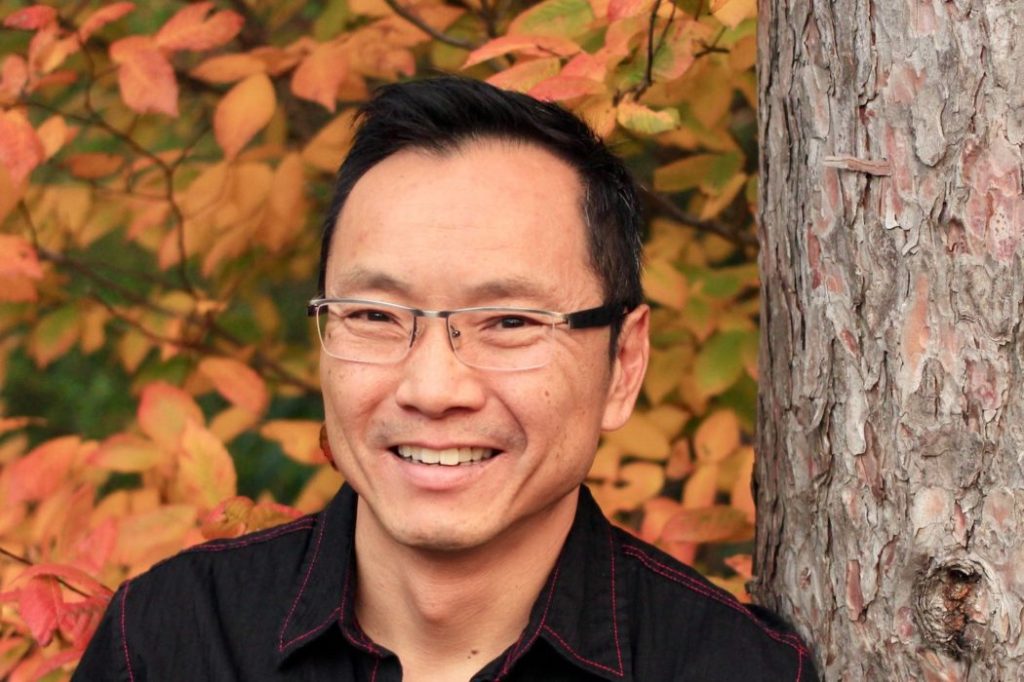
Wayne Ng was born in Anishinaabe land in what is commonly known as downtown Toronto to Chinese immigrants who fed him a steady diet of bitter melon and kung fu movies. Ng is a social worker who lives to write, travel, eat, and play, preferably all at the same time. He is an award-winning author and traveller who continues to push his boundaries from the Arctic to the Antarctic. He lives in Ottawa with his wife and goldfish.
Ng is the author of The Family Code, finalist for the Ottawa Book Award and the Guernica Prize; Letters From Johnny, winner of the Crime Writers of Canada Award for Best Crime Novella and finalist for the Ottawa Book Award; and Johnny Delivers.
Hello Wayne! My name is Nisha Patel andI’m excited to have the chance to chat about Jonny Delivers and delve a little deeper for our readers. Congratulationson your fall launch, and for sharing such a memorable and, at times, heavy story with readers.
To start us off – how and why did you start writing, and how has your practice evolved over time?
I’ve always enjoyed stringing words together, but I’m a late bloomer and didn’t start writing until I was well into my thirties, about twenty-five years ago. I always had other things on the go—primarily travelling, but also work, and feeding my goldfish. I never even self-identified as a writer until the pandemic. However, I now understand that I need to write and I enjoy it immensely. It’s self-expression and creativity, it’s restorative, it’s liberating. It’s recently been full-time. I only wish I had devoted myself to this sooner.
I know Johnny Delivers is a stand-alone sequel to your first story, but I wonder what motivated you to revisit Johnny’s story.Since Johnny’s story first starts when he is much younger in the crime novella Letters From Johnny, how did it feel letting readers back into Johnny’s life now that he’s older and facing these new, overlapping challenges?
Johnny’s childhood quirks seemed like they’d naturally carry over into adolescence, but writing the sequel turned out to be more challenging than I anticipated. While the story shares its DNA with the first book, adding Bruce Lee as a character added complexity and depth. As Robert Frost famously said, “No tears in the writer, no tears in the reader. No surprise in the writer, no surprise in the reader.” I realized I had been playing it safe. Revisiting Johnny forced me to confront difficult memories—family history, adolescent struggles, racism, and my complicated feelings about Bruce Lee. These themes don’t come naturally to many Asian men, myself included. While the story is fictional, facing those truths was both cathartic and restorative.
I think many new writers are taught not to believe in luck, a theme in your novel that gets explored through many competing lenses from Johnny, to Bruce Lee, to Mama.Are there moments where you experienced luck in finding what parts of Johnny’s story you needed to tell?
I believe in good fortune, which I construe as part luck and part earned. The turning point for my story took place while in residency in Vancouver at the Joy Kogawa House. A draft of Johnny Delivers was complete, I was tired of it and deep down I knew it lacked emotional resonance. Putting aside the manuscript, I visited the new Chinese Canadian Museum on Pender. They were showing The Paper Trail, which focused on the married bachelors trapped behind walls of institutional and social racism. My grandfather was one such bachelor. The Museum vividly captured the plight and desolation of grandfather’s journey in a way that revealed the missing core of Johnny Delivers. I was writing a story centered on a teen trying to find a way forward, but in fact he couldn’t move because the past was closed to him. I had to tap into that narrative drive. This made it far more personal and poignant. So yes, a bit of luck and due diligence, thanks to an unplanned museum visit.
Are there writers you would consider your peers in style or subject matter?
I admire and in a way am inspired by Lindsay Wong and Kevin Chong, both of whom aren’t afraid to push conventions on immigrant stories. I also love Lindsay’s sardonic, wry and wacky humour, and have tremendous respect for Kevin’s range. I also need to say that both are exemplary literary citizens, unafraid to support fellow writers.
South of the border, Charles Yu’s Interior Chinatown nudged me to go absurd and satirical in my next project, and Celeste Ng’s complex Asian-American family dramas have always resonated as both a writer and reader.
As an Asian writer myself, I feel some of these family arguments and toxic parenting or dynamics in visceral ways.I’m wondering if there were moments you really emotionally struggled to depict the truthfulness of these types of conflict?
I was hesitant to reinforce the convention of Asian-parents who are restaurateurs, emotionally distant, demanding, burdened by history and of parent-adolescent conflicts steeped in cultural and generational divides. And for all the superpowers Asians have, emotional expression isn’t one of them. It wasn’t like we ran yoga studios and art galleries. Yet there was no escaping the service industry stereotype because there was much truth behind it. The early Chinese were segregated in so many ways, such as where they could live and the types of jobs they could hold.
For most of my life I cringed at such stereotypes and ran from them and my roots. Now I recognize that was internalized racism and shame. Writing Johnny Delivers allowed me to embrace, question and flirt with those conventions and ultimately reclaim them.
You can connect with Wayne Ng on social media and at waynengwrites.com.

 YOUNG ADULTING