Interview by Nisha Patel
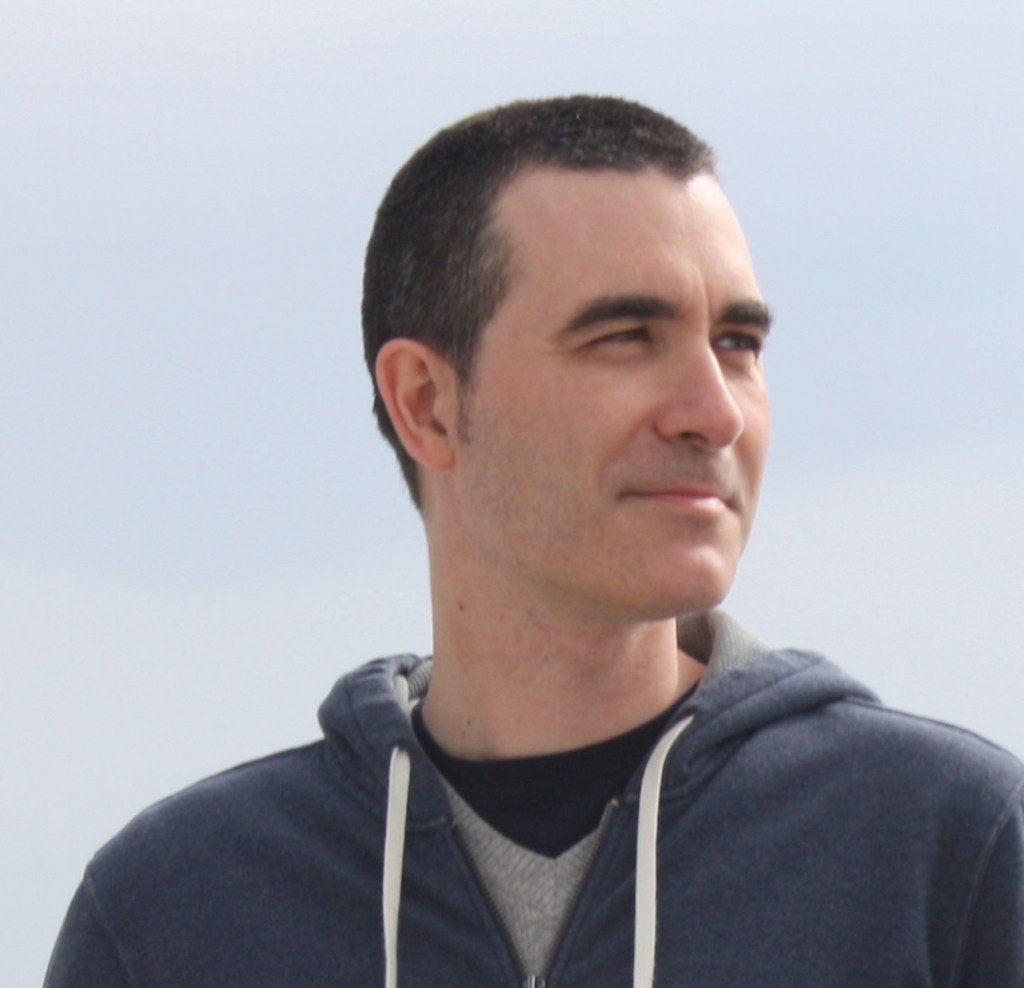
Allister Thompson spent his youth dividing his time between working as an editor for Toronto-based publishers and touring with a rock band. He is also the author of an alternate history sci-fi novel, The Music of the Spheres. He currently runs his own freelance editorial business out of his home in North Bay.
His novel Birch and Jay releases May 24, 2025 from Latitude 46 Publishing.
Thank you for agreeing to visit Young Adulting and chat about your upcoming book. We’re excited to share our review with our readers, and to pick your brain a bit about what it was like to write it, the decisions you had to make, and your goals in the future.
To start us off: the motivations for writing about climate change and collapse seem self-evident for a lot of writers today, perhaps more than ever. The evidence we can see, and feel, can be emotional and overwhelming as we live through it. How do you navigate the seriousness and grief of writing about a post-apocalyptic future while still crafting a story that gives readers something more to turn the page?
I guess I should start by explaining my choices. I realized that the field of “cli-fi” and climate change fiction in general is extremely crowded and only likely to become more so. Nonetheless, when I was pondering, after a break of many years between projects, what I would like to write about, the answer was obvious. I had to deal with my own grief.
It may appear that climate grief is something mainly affecting young people who can see their future being snatched away from them, but whether you’re eight or eighty, if at any point in your life you became aware of humanity’s incredible, wanton destructiveness and our seeming helplessness to stop it, well then, you’ve spent your life bearing that kind of sorrow, and I would certainly say I have. The last few decades almost feel like a self-fulfilling prophecy in many ways.
Still, I didn’t want the novel to be just about grief and horror. Nor did I want to indulge in the standard post-apocalyptic “disaster porn” approach (piling on dangers and horrors) or the sci-fi “let’s science our way out this problem” approach. Lots and lots of books, shows, movies, dwell on those lurid aspects or the silly idea that technology has answers that will fix all of this.
Instead, I envisioned a situation where the collapse has occurred; the land has emptied out; our overtechnologized, consumerist, exploitative “developed” civilization has been wiped out. Many of us understand the sheer unimaginable scale of the tragedy that is coming both to humans and other species as collapse occurs in coming decades. But once this is all gone, then in a way there will be an opportunity presented for the remaining people to set humanity on a new course — if they can learn the right lessons.
That leads me to finally getting around to answering your question! I’m a fiction editor, and I work on dozens of projects per year. One thing I tell clients that never changes, no matter what kind of fiction you write, no matter what genre, is fiction is about people. Characters are the lifeblood of your story.
I knew that I couldn’t just write some bleak tale about a post-collapse world full of disposable characters. I needed to create likable characters you can root for, people that embody this idea that we can be better. You need to want them to succeed and be safe. So to me, having characters who of course contain complexities but are not going to let you down is what carries a story like this. Too often modern writers of fiction, TV, and film conflate “complexity” with behaving badly or making terrible choices (many such choices in one plot, sometimes). I wasn’t interested in that, at all. I wanted my characters to embody the idealism behind the novel’s concept.
In that way, I’m hoping that the story is more interesting or even positive than grief-enhancing for readers. Yes, there’s adventures in here, too, but I’m balancing an idea-driven story with a character-driven one, basically.
You’ve lived and visited a lot of the places that feature in your work – what was it like writing about them and picturing a future that fundamentally shifts your vision of them? If you walk through a place that’s mentioned in your work, do you picture the future you imagine for it now?
This part was actually a lot of fun. Not traumatic at all. “Writing what I know” allowed me to plot out the characters’ journey and place them in real locations. What would the small town of South River look like wrecked? If a character needs to stop for the night, how about a ruined Tim Hortons in Bracebridge? If no one kept an eye on the CN Tower for a few decades, what might happen to it? While I was writing it, yes, I tended to see ruins everywhere in my mind’s eye. That’s settled down now.
Canada’s climate resiliency is closely intertwined with knowledge and wisdom from many of the First Peoples that champion stewardship and story in the present day. How did you approach the research and conceptualizing of the role of Knowledge Seeker, which is the eponymous role in your series?
I came up with that concept when I was pondering the potential for a thoughtful and positive approach. The novel is really about social and political change caused by climate collapse, not the collapse itself. It’s also about finding a way for humans to coexist with everything else, something we’ve totally failed to do, or at least industrialized modern civilizations have failed to do. We see that playing out now as climate denial grows and governments fall one by one to the far right.
I needed a central conflict. How about between the “old” world (meaning the “developed” one we live in now) and the new? Not to offer too many spoilers here, but the Knowledge Seekers represent the “new,” an attempt to reconcile a fresh start with the fact that the old world may contain useful but not damaging knowledge that can be carefully utilized. And of course archival preservation of history.
I do believe there’s something of a loose parallel between the Seekers as preservers and the fact that Indigenous people have had to be determined “knowledge keepers” as an invading force has made a genocidal effort to erase their cultures. That kind of resilience that sees Indigenous people around the world standing strong in defending their cultures and retaining their traditional knowledge is inspirational.
And, of course, as you indicate, the idea of humans as stewards of the land and not exploiters of it is central to Indigenous concepts of a holistic existence in partnership with the natural world. That wisdom predates what I call the “old” world in terms of the chronology of the novel. It’s this wisdom my “settler” characters are finally starting to understand.
I could not write a story set in Northern Ontario without acknowledging the presence of an Indigenous community, which is in this story briefly (and will be more so in the sequel), and since the idea of preservation of valuable knowledge resonates in that way, these communities, those of the Seekers and those of the First Nations, are portrayed as warmly cordial, as I believe they would be. Knowledge from ages past doesn’t just mean technology — it also means going back further to cultures and times when human beings were not so destructive, and then absorbing the wisdom of that worldview.
The whole idea was interesting — what knowledge is worth preserving? And in gathering it, do you risk reopening the Pandora’s box of technology that is destroying us?
Ultimately, while the Knowledge Seekers do actively seek to preserve the best of the past, their philosophy is as much about the “deep ecology” principle of humans making as little negative impact on the natural world as possible as it is about collecting and archiving.
In your wider writing practice, what motivates you to pursue a story through to the end? Did the series come to you in stages, or did the idea of a longer, multi-book story evolve more organically through the writing process?
A lot of this has to with personality. I always finish things. Not always well, but I finish them! For example, as a musician, I have no unreleased compositions in the “vaults.” I finish and release everything!
So I don’t need motivation to do that. It would really have bothered me not to finish writing this novel. As for a series, I actually did not envision this as one. I just wanted to tell a particular story. At that time, I wasn’t even thinking about trying to get it published; I just felt a compelling need to write it. My lovely publisher and editor have encouraged me to make this a trilogy, so I’ve already finished writing a sequel and have plans for a third novel. So, while not “organic” in terms of a process, I have found the ideas came easily in terms of threads from the first book I could continue to develop in the second one.
For those of our writers who are hesitant to write about the places we live in now, what advice can you offer them?
I think it’s really fun to make up new places, fantasy-lands, etc. It’s also enjoyable to write about places you’ve never been, or historical settings, as long as you do your research. My first novel was set in alternate versions of London and New York. So of course that’s a very legitimate thing to do.
This time around, I deliberately wanted to write about places I’d lived. It felt like a tribute to them, and I thought the intimacy might add something poignant. I lived in Toronto for most of my life; the city was part of me. I look at it with affection (and some mixed feelings as well). Now, I live in a very different place, North Bay. A place that has been featured in fiction already a few times, yes, but I see this as an opportunity to find the soul in these places, or what that soul means to me.
I always tell clients their setting is a character in their novel, or it can be. Use your setting and really bring it to life in a vivid way. If it’s a place you know well and love, it will shine through all the more to the reader, far more than if you were setting the story in a place halfway across the world to which you have no connection at all.
 YOUNG ADULTING