
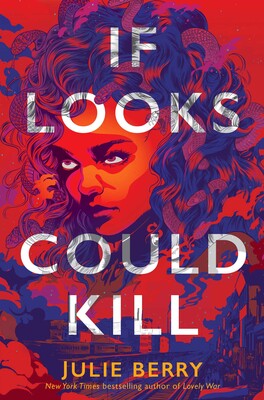
Review by Ash Wahking
Publisher: Simon & Schuster Books for Young Readers
Published date: September 16, 2025
Length: 448 pages
ISBN13: 9781534470811
Hardcover: $21.99/ eBook: $10.99
Ages (on publisher’s website): 12+
Genres: Action adventure, fantasy
Miss Stella smiles. “They rationalize it away, oh, how they do, but make no mistake: men know their lives—every minute of their lives—are on loan to them from the unfair, unpaid or underpaid, unappreciated toil of women. And they can’t live in that imbalance without knowing, deep in the gut, that one day, the bill might come due. Women might rise up in their wrath.” She leans forward in her chair. “Or send a champion to do it for them.”
It’s autumn, 1888, and Jack the Ripper is not the only one on the hunt.
Set on the cutthroat streets of Manhattan, Julie Berry’s novel, If Looks Could Kill, follows a murderer who finds himself on a collision course with a wrathful sisterhood of Medusas, whom his killings have unintentionally awakened.
Tabitha, a dry-witted young woman and Salvation Army volunteer, is the main protagonist. While most chapters are delivered from her point of view, we also hear from a rotation of different narrators including Tabitha’s roommate, Pearl, Jack the Ripper, and other minor characters. At first, Jack and Tabitha’s stories unfold separately; Jack sources his next victim in his search for a miracle cure while Tabitha struggles to get along with Pearl during their missionary work for the Salvation Army. As time passes, Tabitha and Pearl join forces to free a girl from a brothel, unaware that a mythic twist of fate will soon interweave their story with the serial killer’s.
For me, a highlight of Berry’s novel was the cast of fierce female protagonists who take justice into their own hands. Tabitha and Pearl’s journey, from prickly opposites to true comrades-in-arms who would stop at nothing to save each other, was humorous and heartwarming. In addition, I found Freyda, a street-wise and opportunistic journalist (in-training), delightfully bright, spunky, and self-aware. While she does save Tabitha and Pearl a few times, deus ex machina-style, she isn’t infallible, and sometimes suffers the consequences of her bolder actions. When Tabitha blames herself for Freyda’s pain, Freyda takes responsibility for her decisions and helps Tabitha understand that her guilt doesn’t help Freyda, modelling a life lesson and maturity that I rarely see in YA novels.
While the book’s female characters are gutsy and compelling, and its social issues are deeply grounded in historical research, I personally found this novel somewhat overly ambitious in scope. Besides its psychoanalysis of Jack the Ripper and reimagination of Medusa, the story also included a romance subplot, Salvation Army politics, divine intervention, Manhattan’s criminal sex trade, and religious differences. While an impressive endeavour, the many threads and their implications felt somewhat superficially explored. Due to the multitude of storylines fighting for space on the page, I feel like there was a missed opportunity to develop other aspects of the novel, like worldbuilding. I would have loved a deeper dive into the world’s underlying magic/mythic system. For instance, I wondered how Medusas affected world history and if other mythological creatures exist. Although the numerous plot threads did come together in the end, I think a deeper focus on fewer elements would have tightened the narrative.
Despite its ambitious premise, I believe the novel offered an intriguing take on vengeance and punishment. Without spoiling too much, in Berry’s world, Medusas are once-ordinary women whose petrifying gaze haunts or scares bad men into behaving morally, or kills those who are irredeemable. Berry raises engaging questions, including whether death or life-long guilt is the greater punishment, or where the line lies between punishing monsters and becoming monstrous yourself.
Although the publisher lists the intended audience as 12+, I’d recommend this book to older (or, at least, prepared) readers, as it does contain the following subjects: violence, murder, bodily mutilation, cannibalism, human trafficking, kidnapping, and sexual assault. In terms of language and characters, however, I think middle school readers would empathize with and enjoy Tabitha and Pearl’s character development.
Ash was raised in Hong Kong and Singapore, before moving to Canada for the balmy weather and university. Their work has been exhibited in Augur Magazine, Brave New Play Rites, and UBC Magazine. Ash can be typically found haunting bookstores or talking to other odd ducks at her local pond.
 YOUNG ADULTING