
Review by Jayce Desjarlais
Imprint: Heartdrum
Pub date: Sep 17, 2024
ISBN: 9780062870001
List price: $23.99
Pages: 240
Fiction, Indigenous, Coming-of-age
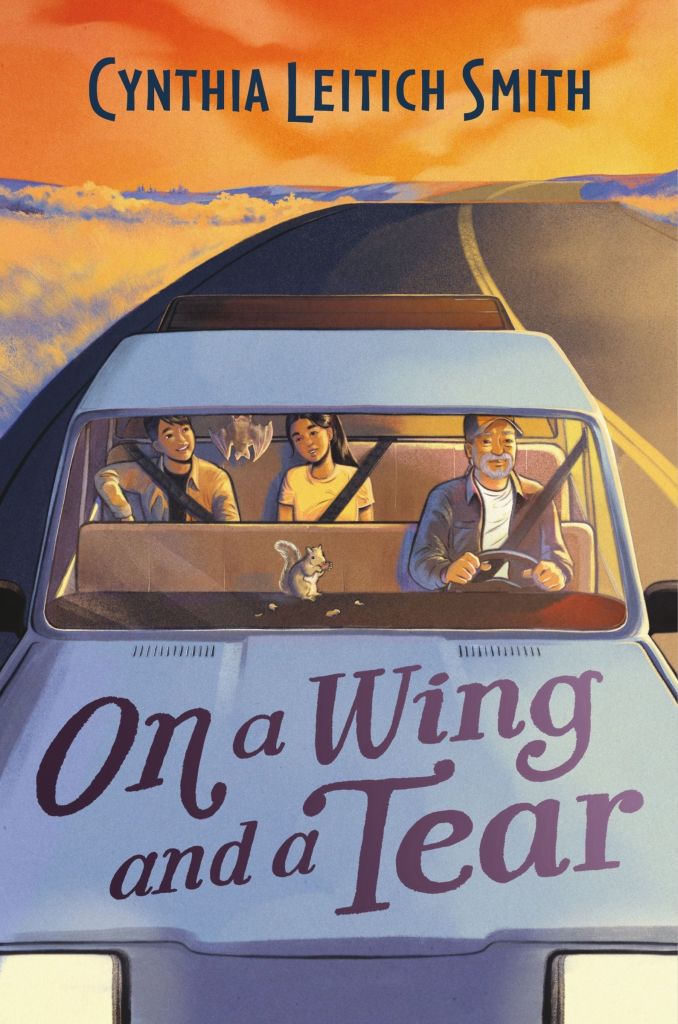
It had turned into a sunny spring day. The suburbs had given way to farmland, broken up by the occasional warehouse or corporate office building. In the pickup truck, our heroes rolled along, cool and breezy as you please with the windows down. The humans were sporting their novelty sunglasses–the ones with the sparkly heart, butterfly, and baseball frames.
Chapter 10, Pg. 128
Cynthia Leitich Smith returns with a middle grade novel bursting with characters that pay tribute to storytelling traditions of Muscogee People, and Indigenous storytelling in general. On a Wing and a Tear captures the adventure of Melanie “Mel” Roberts, Ray Halfmoon, and Grampa Halfmoon with the legendary Great-Grandfather Bat, who’s fostering an injury to his wing. Together, they hit the road to escort Bat to the historical rematch of the infamous Great Ball Game between the Animals and the Birds on the traditional gaming lands in Georgia. On this wild adventure, readers will see the wonderful characters escape Bat-nappers, rekindle an old romance, visit many relatives, encounter mysterious creatures, and find out if Bat’s wing heals in time for the game.
Mel, along with her mother and cat, moved in with Ray and Grampa Halfmoon in Chicago sometime after the divorce of her parents. Mel is of Muscogee, Odawa and French heritage and is passionate about history, especially her research on the Trail of Tears. Ray is of Cherokee and Seminole heritage and is a selfless artist. Ray grew up with Grampa Halfmoon and was taught to be respectful to others and all living creatures. He doesn’t take anything for granted and shares his artwork with others, often as a gift or a token of appreciation. Grampa Halfmoon leads the road trip adventure and is a guiding figure to both the children, while being respectful to Bat’s teachings. He is gentle and isn’t overbearing, often allowing the children to exercise their creative thinking and problem solving throughout the novel.
It’s refreshing to read a story about a non-nuclear family unit, demonstrating that genuine bonds between others can create family-like relationships. Mel and Ray are best friends and their friendship reflects that of siblings; it is pure, honest, heavy at times, and full of laughter, a dynamic that proves to be healing for both of them in ways they didn’t expect. This story does an excellent job at exploring the depth of genuine friendships and the qualities of found family, highlighting that family isn’t necessarily limited to blood relation.
When reading the beginning of this novel, I was full of anticipation waiting for Great-Grandfather Bat’s first encounter with the blended family. As soon as the road trip adventure starts in chapter six, the novel became a true page-turner full of conflict, tension and fun. This story does an excellent job at demonstrating how to respectfully engage with other cultural practices as well as with Elders and figures who hold a higher authority, a common practice amongst Indigenous Peoples. It also highlights the responsible course of actions taken by Grampa Halfmoon, who leads by example, as he clearly communicates in his words, behaviour and actions to the children on how to respond to a variety of incidents. From teaching how to safely interact with animals, to figuring out how to respond after being pulled over by the police, it’s clear that Grampa Halfmoon is a guiding figure to not only Mel and Ray, but for the readers to observe as well.
As a citizen of the Muscogee Nation and author-curator of Heartdrum, an Indigenous-focused imprint at HarperCollins Books, it’s no wonder that Smith’s story offers rich and diverse characters that respectfully and authentically portray current-day Indigenous People. The characters in On a Wing and a Tear aren’t one-dimensional, or treated as figures from a distant past, they reflect urban Indigenous People who actively and shamelessly practice their culture while standing firm in their ways of life. Many Indigenous youths who grew up in primarily urban settings will see themselves through the many positive and heavy traits of these characters.
This is a middle grade novel I recommend for urban Indigenous youth who may feel disconnected from community and family, while affirming their cultural identities. I also recommend this story for non-Indigenous youth to further their understanding of their Indigenous peers while fostering their growing knowledge of Indigenous cultural practices, ideologies and identities.
Jayce Desjarlais is a land-based Métis artist and writer from Gift Lake Metis Settlement, AB. She is a second-year student in the Master of Fine Arts in Creative Writing program at the University of British Columbia. Jayce primarily writes stories about Indigeneity pulling from her personal experiences and the memories of her family and ancestors, as well as writing about the unique identity of land-based Métis. She comes from a long line of strong, Métis matriarchs and carries the last name of her Câpan or Great-Grandmother. Jayce is also passionate about preserving the Cree language with her stories often including Cree, but in the Woodland dialect.
 YOUNG ADULTING