
Interview by Sophia Thomson
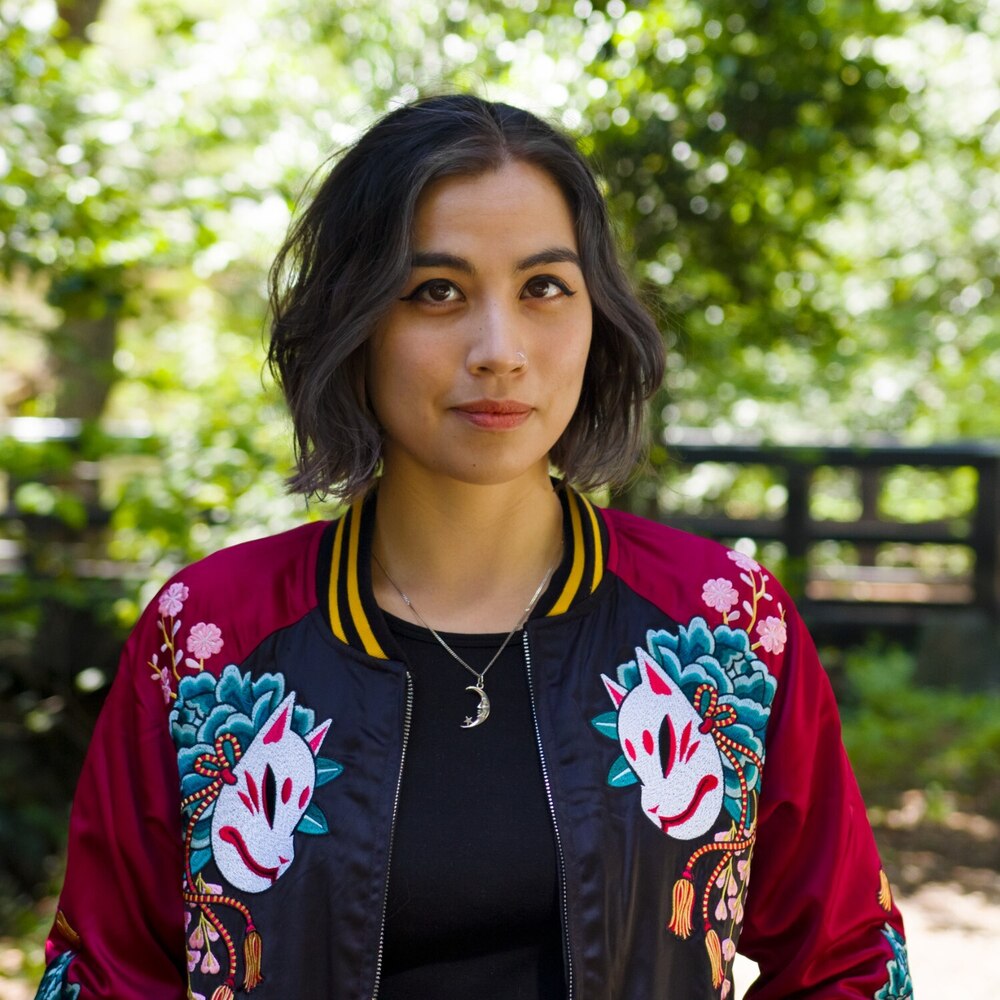
CLARA KUMAGAI is from Canada, Japan and Ireland. The recipient of a We Need Diverse Books Award Mentorship, Clara was also a finalist for the Jim Wong-Chu Emerging Writers Award, a Yoto Carnegie 2024 nominee and shortlisted for the KPMG Children’s Book Ireland Award. Clara has been chosen
by The Irish Independent as a Top 20 Irish Kid’s Book of 2023, as well as a Best Book of 2023 by The Irish Times, the Observer and Waterstones. She is the author of Catfish Rolling.
Dear Clara,
It is an absolute treat to have you back with us at Young Adulting. We were thrilled to get a chance to chat with you about your debut YA novel, Catfish Rolling, back in March of 2024 and it only makes sense to kick off 2026 by chatting with you about your newest YA novel, Songs for Ghosts. This whole novel felt like a masterclass in craft and finding balance as you tackle a number of themes including those of belonging, family, grief, sexuality, and Japanese-American diaspora (to name a few). Just as Adam was enthralled by the diary he finds, I was completely drawn into Adam and the diarist’s intertwining stories in Songs for Ghosts. All this to say, thank you for being here, and let’s jump into the questions!
In your authors note, you share that the inspiration for this novel came from Puccini’s opera, Madama Butterfly. Through that, we see the inspiration of the mystery diarist’s life and story. I’d love to know where Adam’s story came in and how it found you/you found it? How did you decide to intertwine these two distinct characters?
I saw Madama Butterfly in Vancouver in 2016, and I was left wondering about two stories I felt were untold—the heroine Cio-Cio-san’s and her son’s. This was particularly because Cio-Cio-san’s son is Japanese-American, and it made me think about what his life would be like, growing up in the US in the early 1900s. I wrote a short story afterwards from the son’s point of view as he begins to be visited by a ghost but it never quite worked, and then years later it became a starting point for Songs for Ghosts. The diary element came about because I wanted the diary to relate her own experiences, but I also wanted Adam to be able to read and connect with it.
There are layers upon layers of story within this beautiful novel: Adam’s, the mystery woman’s, the history of the biwa, much of Japan and its military expansion, and of course the stories shared in the diary entries themselves. Of all the stories and folklore the diarist recounts and Adam reads, was there any one story you felt especially important to include and share?
Yes, I wanted to create the sense of echoes throughout the narrative—of stories being retold and passed down in different ways. I had actually written about Lafcadio Hearn (an Irish-Greek writer who wrote some of the first translations of Japanese folklore into English) years before, and even visited his old home in Matsue, Japan. In one of his travelogues, he includes a short story about a child-rearing ghost which ends with the line “Love is stronger than death.” That always stayed with me and I think it encompasses one of the book’s themes. Fun fact: there is one folklore story that I made up and is not a retelling!
Adam and the diary writer have such distinct voices. Adam with his more dry, current teen voice versus the more reverent and formal tone the diary carries – can you share some of your process with crafting voice and share best advice for cultivating distinct characters?
I’m usually led by voice in my writing, so that’s generally a starting point for me. In Songs for Ghosts, one of the useful elements is that Adam and the diary writer are separated by over a hundred years, so their way of speaking, the language they use, the vocabulary, is naturally very different. Adam’s story is told in first person, so it’s immediate and the reader is right in his head. For the diary writer, she is recounting her experiences, ideas and reflections in a much more intentional way—she, too, is writing. The diary is addressed to her grandmother, which I found was a good way to direct her writing and make it more conversational, and this also helped with tone and the storytelling style. I think my best advice for cultivating distinct characters and voice is to consider their context—not only personality and characteristics, but the society, home, and environment in which they are living. I made sure to include Japan’s social and political movement at the time (from the 1910s onwards) which was defined by imperialism and the brutal occupation of East Asian countries such as Korea, Taiwan and China. However, for the diary writer I also had to consider how informed she might have been, how she would have been able to think critically and discuss this issues. I had to do a lot of research and then also really see through her eyes—what range of vision did she have? That means really getting into a character’s head, and the more you can do that, the more the voice will solidify.
Throughout Songs for Ghosts, many families are introduced and have some kind of fracture or tension within that structure, yet the story still brings people back together in one way or another. What drew you to the themes of family and portraying family as something that can be broken but not entirely lost?
I didn’t set out to centre family as a theme, but that’s what it became! I wanted to show complex relationships the characters have with their families—there is conflict, reckonings and resolutions. Through that, particularly for Adam, there are a lot of realisations and learning that he has to do, and that’s partly because when he goes to Japan he has to work out how he connects with his heritage. I also wanted to show the different forms family can take, and how they are formed, fractured and repaired.
The ghosts in this novel are often people lost, grieving, and looking for help passing on. At the same time, you’ve written some magnificently chilling scenes with ghosts in this novel (bravo!) which led me to wonder, how do you feel about ghosts?
To be honest, I am a huge scaredy-cat and cannot watch horror movies or anything very violent! But I’ve always loved ghost stories because they’re so effective at creating tone—a creeping, jumpy dread. I also think that ghost stories are some of the last oral stories that people are familiar with recounting and sharing. I wouldn’t say I’m a believer in the paranormal but I have also had some ghostly encounters! Every ghost story is also a history—it’s always about the past, and about things left unresolved or events in which justice has not been done.
Are there any final words/parting thoughts you’d like to share with readers about Songs for Ghosts that you didn’t get to through these questions or in other interviews?
I tend to get pretty into research for my books, and I did a lot for this one (it helps that I like talking to people!). I’m certainly not the first to reinterpret Madama Butterfly, and one of the most interesting people I spoke to was Aria Umezawa, a Japanese-Canadian opera director, who spoke about the challenges she has faced in staging reimagined productions. I also found an Irish biwa player, Thomas Ranjo, who shared his deep knowledge of biwa and performed for and with me. And because Adam plays the cello… I took cello lessons for a year. (I am not good.)
Lastly, we’d love to know if you have any more works in progress and what’s next for you?
I’m working on a graphic novel text (I’m not an illustrator!) and a new YA—both very much set in Ireland and involving Irish folklore!
Want to hear and learn more? Hannah Luppe interviewed Clara about her debut novel, Catfish Rolling in 2024! Still not enough? (Of course it isn’t), we also have a review up!
 YOUNG ADULTING