
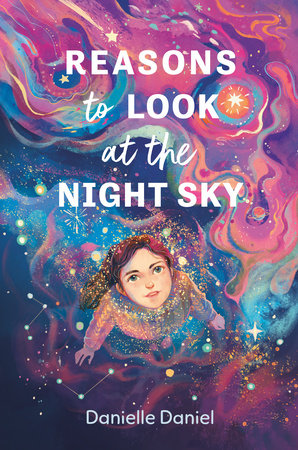
Review by GiGi Kang
Tundra Books, PUB Oct 29, 2024
328 pages, hardcover, $23.99 CAD,
978-1-7748-8353-2
9 to 12 years
Genres: Poetry/Verse
“Then, I close my eyes
and I do what I do
every night.
I picture myself floating
in my astronaut suit,
staring at our planet
in the great distance,
feeling light and relaxed—
not feeling motion sick
whatsoever,
surrounded by millions
and millions of
twinkly stars,
thousands of light-years away.” (201)
Eleven-year-old Luna Harriet McKenna’s biggest dream is to be an astronaut. There is nothing she loves more than the wonder of outer space. She has a crystal-clear vision of her future, but when her teacher, Mr. Griffin, has to take leave right before the space unit in class, her big ideas come crashing down like an asteroid.
Reasons to Look at the Night Sky by Danielle Daniel is a middle grade novel in verse that takes place in Ottawa where Luna lives with her florist and poet mother, astronomer father, and ninth-grader older brother, Leo. Daniel first establishes Luna’s commitment to science through her family, especially her relationship with her mother. The latter’s way of seeing the world is rooted in art while Luna doesn’t see the value in poetry or visual art; she believes in scientific explanations.
But Luna’s mother remains patient, explaining on page 234, “‘I realize we have our differences, Luna, but that’s what makes us special.’” Through the mother-daughter relationship, Daniel shows the importance of integrating differences rather than allowing negative judgements to taint opportunities for connection.
From there, Daniel introduces a similar dynamic between Luna and her substitute teacher, Ms. Manitowabi, who arrives unexpectedly upon Mr. Griffin’s leave. Much like the resistance Luna feels toward her mother’s way of seeing the world, Luna panics when Ms. Manitowabi shares that her teaching methods will intertwine science and art. Luna is disappointed about the curriculum change because her goal is to get the highest mark in her class so that she can ace her application to the Exploration Science NASA Camp—without Mr. Griffin, who promised to provide a reference, her goal feels threatened.
Over time, Ms. Manitowabi’s fresh perspectives transform Luna’s understanding. The clearest example occurs when Ms. Manitowabi takes the class on a field trip to the art gallery. At first, Luna considers faking a sickness to avoid the field trip, but she chooses to prioritize her academic goals and not miss out. She walks around the gallery, begrudgingly, until she notices “a large and beautiful / painting of a starry night, / and it’s not the famous / van Gogh one / that everybody loves so much” (263). Luna is drawn in, enamoured, and thinks, “I’ve never felt this way / staring at a painting before” (264).
The pivotal moment catalyzes Luna’s acceptance of the interconnection between art and science. The painting makes her think, “Maybe there is / something to this / mash-up after all” (265). The moment illustrates to young readers the learning that can come from stepping out of one’s comfort zone and considering new perspectives.
Ms. Manitowabi also aids in expanding Luna’s worldview as she introduces the class to Indigenous knowledge, including Sky Stories. On page 143, she shares, “‘Before Western maps / were ever created, Sky Stories were shared / and honored.’” Luna can’t believe that she was unaware of Sky Stories despite being outer space’s biggest fan. In a tender moment with her father, Luna expresses her confusion and disappointment as to why Sky Stories would be overlooked. On page 155, her father is receptive, saying, “‘I’m sorry I never mentioned it to you. / I should have. / I should have steered you / to some books and / Indigenous astronomers.’”
The important conversation between Luna and her father acts as an encouragement to not only young readers but also parents, guardians, teachers, and others in influential roles to seek stories that have been erased. Reasons to Look at the Night Sky emphasizes the need to take accountability and begin integrating previously erased perspectives into daily life.
In addition, the honest conversation about Sky Stories brought up what was described as “an uncomfortable feeling” (157). Through this, Daniel shows that growing up and encountering new ways of thinking won’t always be pleasant—and it’s okay to feel that because a deeper understanding of the world is on the other side of that initial discomfort.
Overall, Daniel establishes vivid characters that feel real because they are flawed. As shown through her tendency to be guarded when facing change, Luna isn’t a perfect character. She gets jealous, irritated, and was very resistant to Ms. Manitowabi at first. In other words, she is a regular eleven-year-old who is learning how to learn. Daniel illustrates both the frustrations and revelations of Luna being exposed to new information, making the story believable because it communicates to young readers that perfection is not needed.
Reasons to Look at the Night Sky is a touching reminder of open-mindedness that is important at every age. An unexpected shift changed Luna’s entire approach to her greatest passion. Sometimes it is unplanned connections that end up informing our next steps, if only we are willing to learn from them. I will leave you with a consideration that Luna makes on page 280: “I guess, sometimes / it’s good / to let fate decide / things for you / after all.”
GiGi Kang studied English Literature and Creative Writing at UBC. In addition to her creative writing, she is a music writer at LA-based magazine The Luna Collective where she interviews creatives and enjoys learning of their stories. You can read more of her work at gigikang.com.
 YOUNG ADULTING