Interview by Cid V Brunet
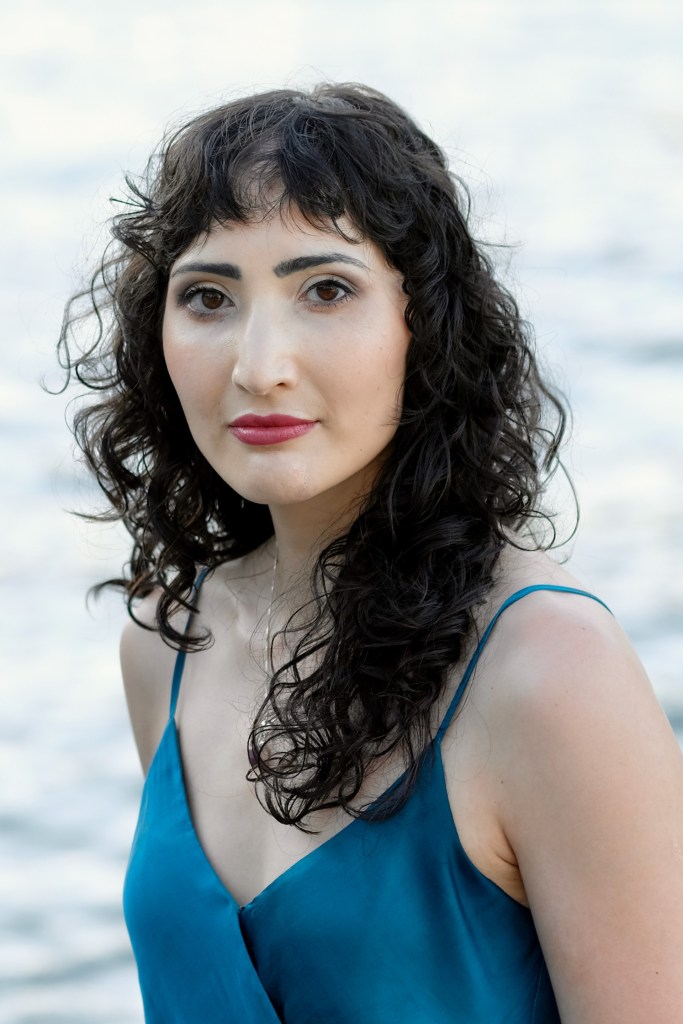
Léa Taranto is a disabled Chinese Jewish Canadian writer who lives with OCD and comorbid disorders. An MFA graduate of the University of British Columbia, alumnus of Simon Fraser University Writer’s Studio, and member of PRISM International’s poetry board, she resides on the traditional, unceded land of the hən̓q̓əmin̓əm̓ (Halkomelem) and Sḵwx̱wú7mesh (Squamish) speaking peoples in BC. Her writing has been published in the anthologies Emerge 20, and Upon a Midnight Clear: More Christmas Epiphanies as well as in various Canadian literary journals. A Drop in the Ocean is her debut novel.
Léa’s novel, A Drop in the Ocean released May 20, 2025 from Arsenal Pulp Press and is available now! Check it out here.
Young Adulting is so grateful to have had the opportunity to get to know Léa and Cid through this process. Both are warm, kind, and extremely talented. The following interview was conducted by UBC’s very own Cid V Brunet.
Cid V Brunet published their debut memoir, This Is My Real Name, with Arsenal Pulp Press in 2021. With recent poetry publications in CV2 and Eavesdrop magazine, Cid has been working on their MFA at UBC while living in Montreal/Tiohtiá:ke.
We hope you all enjoy this vulnerable and honest interview as much as all of us at Young Adulting have.
Dear Léa,
It was such a pleasure reading your debut auto-fictional novel, A Drop In The Ocean, where teenaged protagonist, Mira, is institutionalized at the Residency Adolescent Treatment Centre for obsessive compulsive and comorbid disorders. On her journey, Mira learns new ways of interacting with her obsessive thoughts, and the compulsions they demand, while making friends, falling in love, and mourning her gung gung’s death. Your vividly emotive and embodied writing style illuminated Mira’s experiences in a brilliant and brutally honest way. I can only imagine how challenging it was to translate your own personal experiences into such a thrilling and heart-warming story. I’m excited to ask you some questions about it.
Can you describe what the genre of autofiction means in the context of your story? How closely do Mira’s experiences mirror your own?
All of Mira’s obsessions, compulsions and comorbidities are mine, and almost everything in the book did happen at some time in the early 2000s. The fiction part of autofiction comes through in how I cherry picked events from across several years and locations. As well as through how Mira’s character growth, like her progress in treatment, are condensed and sped up. To protect the privacy of others, characters have pseudonyms. Some, like Sweets, are composites based on more than one person.
The biggest reason this isn’t memoir though, is because my own memory isn’t vivid or accurate enough to create a gripping story. For example, I can’t remember conversations from almost two decades ago. My journals from back then are introspective vs informative of actual events. They’re full of sentimental prose about how much I loved my family and hated myself. What the prose illustrates, and what I do remember, is being in emotional overdrive 24/7. Especially the limbic, fight-or-flight urgency surging through me whenever I cycled through obsessions or performed compulsions. That meant I had to choose between two kinds of truth. The meagre truth of what I did recall or the emotional truth of what it actually felt like to be a teen with life-threatening OCD in psych care.
What aspects of writing about OCD were the most challenging for you and what aspects came easiest?
For Mira’s OCD, I wanted to convey how the only thing that matters to her when performing compulsions, especially those related to her mom’s safety, is their perfect completion. E.g., doing the rituals right. Her primal need and fear are so overpowering she will fight authority figures to finish excruciating rituals. This wasn’t too hard because I could specify the high stakes and show that urgency manifested in hyperbole, for example page 101’s : “…things that feel so wrong it’s like me and the entire universe are exploding until I fix them with rituals.” Along with embodied concrete sensory details like page 77’s, “My heart, it’s stampeding… my pulse throbbing at my wrists, at my neck. All this energy and heat just storming around inside me.” Sharing more about Mira’s exposure therapy process through charts and lists was also easy.
I found explaining the very idiosyncratic, hazy logic of Mira’s obsessions challenging because I still feel a lot of shame over their bizarreness. An easier to grasp obsessional seed would be when Mira learns that the number fifty-two was her gung gung’s car racing number and incorporates it into new rituals while grieving his death.
The most difficult part of my OCD openness has been less about writing and more about vulnerability. I am still nervous about public reception to my OCD at its worst.
What themes did you explore through Mira and Nick’s relationship?
The way first love can change someone’s life for the better but isn’t and should never be the only thing defining you or your sole impetus for personal growth or recovery. Both Mira and Nick witness each others’ breakdowns and unhealthy coping mechanisms and must reconcile their love with the fact that neither can fight the other’s battles for them.
The character Nick is based on, Shaun, was in treatment for his own reasons. Once he had more coping skills, he left his unit while I stayed on mine. That meant I had to take my newfound excitement that maybe I could be the kind, smart, person he saw, and move forward. A lesson I had to relearn in April 2021 when multiple trials Shaun faced resulted in his death. Afterwards, I turned to drafting A Drop in the Ocean as a coping mechanism, much the same way as I’d turned to journalling in my teens. Getting to keep Shaun alive through the character of Nick was a comfort. While reflecting on how Mira could still find things that brought her joy and meaning beyond any one relationship motivated me.
What role do you think imagination and fantasy can play for teenagers who are in a state of incarceration?
Escaping into the realm of imagination can be a life-saving distress tolerance skill for incarcerated teens. When in psychiatric crises, engaging with stories in print, on screen, etc., is a triumph of constructive coping mechanisms over destructive ones. Meanwhile, creative expression through writing or art making might be one of the only ways a teen can exercise agency during their institutionalization.
In therapy, the framework of archetypes like those found in fantasy can help teens put words to their experiences. For example, those having trouble separating themselves from their mental illness and/or harmful coping mechanisms might be asked to externalize their condition. A common exercise involving imagination is to give that condition a name and distinct appearance where something like aggression might be conceptualized as a fire demon. Using analogies or comparing their situations to those of characters in a story can give teens the distance they need from a behavior or event to understand it with more nuanced objectivity and less judgement.
What would Mira say to a teenage reader who is struggling with their mental health?
No matter where you go you will always be in your own mind. Sometimes it can be a scary place if you’re having disturbing thoughts or experiencing intense distress, but it won’t stay that way. All thoughts and emotions are finite. You always have the power over what you do in response to any of your thoughts or feelings, including how much importance you place on them.
For someone about to begin treatment, inpatient or otherwise, it’s okay and expected that you will still have days of struggle. Mental illness is lifelong and the cure narrative (enter a psych ward and exit it “fixed,”) is a dangerous oversimplification. A far more realistic, effective way of framing a slip is not as a failure that invalidates all your work, but as something you can learn and move on from.
That same school of thought can apply to other mistakes. As Mira all grown up, I still have to remind myself that cognitive distortions like perfectionism are harming not helping me. Especially the notion that worth comes from how well you perform. You can’t hurt or hate yourself into being a better person. You are worthy because you exist and because you exist, you have the power to make your own mind and the world a kinder place.
If you’re finding life unbearable for any reason, please reach out. Find someone you trust and ask for help. You don’t have to do this alone. You deserve to live. You are enough.

