Review by Tatjana Huber
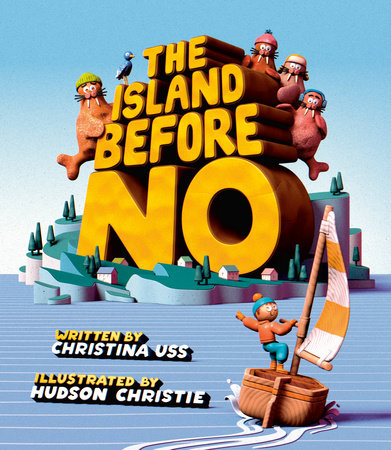
Written by: Christina Uss Illustrated by: Hudson Christie
Published by Tundra books on July 16, 2024
Pages: 56
Age Range: 3-7 years
ISBN: 9780735272415
$24.99 CAD,
ISBN: 978 – 0 – 7352 – 7241 – 5
Genre: Fiction
Have you ever wondered what life would be like if the answer to your every wish was…yes?
Cake for breakfast?
Yes!
Can I stay up late?
YES!
In Christina Uss’ picture book, The Island Before No, that is exactly how life works. On an island inhabited by unnamed walruses, every question is met with an affirmative. For the most part, life seems quite pleasant. Even when the walruses say yes to things they don’t really want to (like wearing an itchy shirt), life continues smoothly, as saying no simply isn’t part of their vocabulary.
Life on the island shifts dramatically when a child arrives, and with their arrival comes a new word: “no.” This child and its two-letter word forces the walruses to practice something they’ve never done before; they must start expressing their own boundaries.
Uss handles this idea with whimsy and depth. Even though narration is used sparingly, it’s poetic and playfully delivered. Uss manages to convey how difficult and uncomfortable saying no can be, but how necessary it is.
This message is strengthened immensely by Hudson Christie’s claymation-inspired work, which brings the story to life beautifully. Christie’s choices are powerful and effective. In the story’s beginning, the child’s arrival is marked by a large, looming wave that crashes onto the island, immediately communicating the force and impact this event will have.
As the story progresses, the walruses keep agreeing to the child’s queries, but the illustrations of their furrowed brows and sorrowful expressions reveal their growing sadness and anger at what they cannot yet articulate. The illustrative choices, in tandem with the text, show the emotional cost of saying yes when you really mean no – a lesson that extends far beyond childhood.
Before they know it, the walruses’ island is overrun with the child and the friends he invites, and the walruses realize they must find a way to express their boundaries. Unfortunately, the walruses’ struggle to formulate a ‘no’ as strong and firm in tone as the ‘no’s’ expressed by the children.
As such, a “no” that is said too feebly, expressed too softly and timidly, is illustrated as a floating word that comes from whichever walrus who expresses it. They are not firm declarations, instead, Christie artistically renders the word to look like a bubble, which can be “see-through like glass,” or “light as dandelion puffs.”
These early ‘nos’ feel fragile and easily overridden, mirroring the walruses’ uncertainty over whether they can stop the rampaging children.
What I truly appreciated about this picture book is that rather than presenting refusal as a single decisive moment, the book shows ‘no’ as something that can be tentative, uncomfortable, and still meaningful. When the child actually accepts the first spoken “no,” the moment comes unexpectedly, offering a sense of relief that reinforces the book’s central message: boundaries do not need to be forceful to be valid, they simply need to be respected. As the children crash into the walruses’ ‘no’s,’ which have taken on physical form, the word becomes tangible and turns into a mark of a physical boundary.
At the same time, the book allows room for nuance. ‘No’ can be warm or firm, used selfishly or for wellbeing, easy to say or deeply uncomfortable. Sometimes it doesn’t mean you can’t do anything, just not this one thing.
The Island Before No is a thoughtful and emotionally intelligent story that gives shape to a difficult concept without oversimplifying it. By showing that boundaries can be hard to express, but are still worth expressing, it offers young readers a powerful and lasting lesson, underlined with imagery that is sure to make readers smile when they spend time with this book.
Tatjana Huber is pursuing her graduate degree in Environmental Sciences at the University of Copenhagen, but found her way to UBC to take Creative Writing classes. In her free time, she can be found crocheting between wobbling stacks of books, practicing photography, and painting little frogs. Occasionally, she remembers she is supposed to be writing her thesis, and does that, too.

